
10 Top Home Theatre Power Managers [Must-have] (2026 Guide)
📌 Key Takeaways: Choosing a Home Theatre Power Manager
- A power manager is not the same as a surge protector. A power conditioner filters noise and regulates voltage; a surge protector only diverts excess voltage. Most home theatres need both functions in one device.
- Match the joule rating to your equipment value. More expensive gear needs a higher energy absorption rating. A $300 soundbar does not need a $500 conditioner; a $10,000 projector does.
- Outlets matter more than features. Count every plug in your rack — TV, receiver, subwoofer, console, streamer, router, lamp — and buy a manager with at least two spare outlets.
- Isolated outlet banks reduce interference. Digital devices, analog amplifiers, and high-current subwoofers should be on separate filtered banks. This is the single most useful feature beyond basic surge protection.
- Clamping voltage is the spec that protects your gear. Lower clamping voltage (measured in volts) means the surge protector acts sooner. Look for 330V or lower for sensitive AV equipment.
- The best value pick is usually a Panamax or Furman. Both brands offer entry-level units under $200 and premium units above $500, with the same core protection technology scaled up.
- Introduction: Why a Power Manager Matters
- Why Is a Power Manager or Conditioner Essential for Your Home Theatre?
- Factors to Consider When Purchasing a Home Theatre Power Manager or Conditioner
- The Difference Between a Surge Protector and a Power Conditioner
- How a Power Conditioner Actually Works
- Joule Ratings and Clamping Voltage Explained
- How to Size a Power Manager for Your Home Theatre
- Outlet Types and Isolation Banks Explained
- How to Install a Home Theatre Power Manager
- 10 Best Home Theatre Power Managers and Conditioners
- Power Manager Comparison Table
- Power Manager Maintenance and Testing
- Repair or Replace a Power Manager?
- Home Theatre Power Glossary
- Frequently Asked Questions
- Final Thoughts
Introduction: Why a Power Manager Matters
Get ready to explore a device of great significance for your home theater system that you might not know about. Through this all-encompassing piece, we will educate and inform you on the subject of a power manager or conditioner designed exclusively for home theaters – an essential addition to enhance your movie-watching experience. By the end, you’ll feel compelled to invest in one yourself!
Similar to your beloved household electrical appliances, caring for and maintaining your home theater system is crucial. Given its significant expense and the inconvenience of frequent replacements, safeguarding it becomes necessary.
Have you ever been curious about the function of a home theater power manager or conditioner? Let me clarify its purpose. A power manager plays an important role in maintaining optimal performance for your equipment by removing any harmful components within “dirty power” that could damage the systems and reduce their lifespan.
The flow of electricity through your equipment poses a risk as even the slightest changes or surges can cause internal harm. However, introducing a power manager or conditioner resolves this issue by eliminating disruptions and safeguarding your interconnected devices. Consequently, all components in your home theater setup such as speakers and subwoofers have prolonged longevity which contributes to an overall gratifying experience.
In this article, we will thoroughly explore home theater power managers and conditioners. We’ll explain their essentiality and offer tips for selecting the perfect power manager. Moreover, you can discover our carefully curated selection of the ten best available in today’s market.
Upon completing this article, you will possess a thorough understanding of home theater power managers. This knowledge will equip you with the confidence to determine whether or not a power conditioner is necessary for your home theater setup. Additionally, top-of-the-line options for home theater power management will be readily familiarized so that an informed decision can be made.
Why Is a Power Manager or Conditioner Essential for Your Home Theatre?
A power manager is a vital component that is often overlooked when assembling the perfect home theatre setup with high-end audio equipment, despite investing significant time and money.
Your valuable home cinema requires protection and upkeep. While we’re careful to prevent physical damage from external sources – keeping gadgets away from water or inaccessible to pets – internal maintenance is often overlooked. Just as with our own health, it’s essential to prioritize the well-being of technological components internally, since addressing these issues can easily prove more complex than surface-level ones.
Home theatre power management is absolutely crucial in achieving an optimal and long-lasting system for the ultimate in-home cinema experience. Its importance lies in providing smooth internal operations and protection of your equipment from potential electrical disturbances. By choosing a reliable power manager or conditioner, you are able to extend the lifespan and enhance performance of components such as speakers, subwoofers, and other devices that contribute to creating exceptional entertainment experiences at home.
Factors to Consider When Purchasing a Home Theatre Power Manager or Conditioner
Choosing the right power manager for your needs can be a daunting task due to the multitude of options available in the market. To make an informed decision, consider the following essential factors:
- Quality: When it comes to a device that will be interconnected with your expensive home theatre tech, prioritizing superior quality is crucial. Ensure that the power manager can accommodate the number of devices in your setup, providing an adequate number of outlets. Additionally, assess the noise filtration capabilities of the power manager to ensure it can handle the requirements of your equipment.
- Price: Quality and price often go hand-in-hand. To acquire the best power manager, it’s advisable to invest more. However, it’s essential to assess the overall value of your current home theatre system. If you have lower-end Sony soundbars or a limited number of devices, a higher-end power manager may not be necessary. Conversely, if your setup consists of numerous devices, soundbars, speakers, and subwoofers, investing in a higher-quality power manager becomes a wise choice to protect your valuable equipment and ensure smooth operation.
- Outlets: Consider the number and placement of outlets on the power manager. Evaluate the number of devices in your home theatre setup and ensure that the manager provides sufficient outlets. It’s always better to have more outlets than you initially anticipate. Furthermore, analyze the positioning of the outlets to ensure compatibility with the various plugs in your setup.
- Filtration: Take into account the filtration rating of the power manager. Pay attention to the clamping voltage, which determines the level at which the surge protector shuts down during extreme voltage levels, protecting your devices from overload burnout. The clamping voltage typically ranges from 120V to 400V for most power managers or conditioners. Additionally, consider the energy absorption rating, which indicates the power capacity the manager can handle based on the number of devices in your setup.
- Size: Consider the size and aesthetics of the power manager, taking into account its placement in your home theatre setup. Some managers can be wall-mounted, while others can be placed on a media or TV unit. Choose a size and design that fits seamlessly into your home cinema environment or can be discreetly hidden from view.
The Difference Between a Surge Protector and a Power Conditioner
Although both a home theatre surge protector and a power conditioner can enhance your home cinema setup, they perform distinct tasks. A power conditioner, also referred to as a home theatre power manager, includes EVS technology which enables rapid shutdown of your equipment upon detection of high voltage levels. This feature shields your valuable audio system from harm caused by electrical surges with great efficacy.
The primary purpose of power managers is to protect your devices from potential electrical hazards by providing surge protection and safeguarding against power drops. They also incorporate filters that mitigate noise from the power supply, resulting in cleaner energy for your equipment and improving your home theatre experience.
In contrast, surge protectors are intended to redirect extra power from your gadgets during energy spikes. Despite providing a certain degree of protection, they do not possess the comprehensive capabilities that a power manager offers. Due to their inability to cut off electricity like power managers can, appliances may still be susceptible to severe surges in current when connected with surge protectors alone. Furthermore, noise filtration is typically lacking compared to what is available through using a designated power management system.
How a Power Conditioner Actually Works
Marketing descriptions of power conditioners make them sound almost magical, but the technology inside is straightforward once you understand the three stages. Every dedicated power conditioner, from a $150 Furman to a $1,000 Panamax, performs these three functions in some form.
Stage 1: Surge Diversion
Metal oxide varistors (MOVs) or gas discharge tubes clamp excess voltage before it reaches your equipment. During a surge, the MOV’s resistance drops to near zero and shunts the excess energy to ground. This is the same basic mechanism a $20 power strip uses, but premium conditioners use larger MOVs, faster response times, and multiple stages of protection that survive repeated surges without degrading.
Stage 2: Noise Filtration
Noise from motors, dimmers, and switching power supplies rides on the AC line at frequencies far above 50 or 60 Hz. Filter capacitors and inductors remove this noise before it reaches your audio gear. Filtration is rated in decibels of attenuation, usually written as “reduces noise by X dB.” Higher numbers mean better filtering, but the audible difference between 30 dB and 40 dB is smaller than the numbers suggest.
Stage 3: Voltage Regulation (Optional)
Only more expensive conditioners include automatic voltage regulation (AVR). An AVR circuit steps the AC voltage up or down to maintain a steady 120V output, even if the incoming voltage sags to 100V or spikes to 135V. This protects tube amplifiers, projectors, and any component with a linear power supply from brownouts and overvoltage. Cheaper conditioners only offer surge diversion and noise filtration, which is adequate for most solid-state electronics.
Joule Ratings and Clamping Voltage Explained
Two numbers on a power manager’s spec sheet matter more than any others for protection: the joule rating and the clamping voltage. Most buyers skip them and buy based on outlet count, which is the wrong priority.
| Spec | What It Means | What to Look For |
|---|---|---|
| Joule Rating | The total energy the protector can absorb before it fails. Higher is better, and the number compounds — a 4,000-joule unit handles multiple times the energy of a 1,000-joule unit. | 1,000+ joules for a basic TV setup; 2,000+ for a mid-range home theatre; 4,000+ for a premium system with a projector and separate amplifiers. |
| Clamping Voltage | The voltage at which the protector starts diverting excess energy to ground. Lower is better because the protector acts sooner. | 330V or lower. Anything above 400V is not suitable for sensitive AV equipment. |
| Response Time | How fast the protector reacts to a surge. Measured in nanoseconds. | 1 nanosecond or faster. Premium units respond in under 0.5 nanoseconds. |
| Maximum Surge Current | The largest single surge the unit can absorb, measured in amps. | 30,000A or higher for a whole home theatre rack. |
| EMI/RFI Attenuation | How much electrical noise the filter removes, measured in dB. | 30dB or higher. Furman’s LiFT and Panamax’s LiFT are both well-regarded technologies in this range. |
⚠️ Joule Ratings Are Cumulative, Not Infinite
A surge protector has a finite number of surges it can absorb. Once the MOVs have absorbed their rated energy, the unit stops protecting — sometimes silently. If you live in an area with frequent thunderstorms or power-grid instability, replace a protector that has absorbed a major surge rather than assuming it is still protecting your gear. Many premium units include an indicator LED that turns off when protection has been depleted.
How to Size a Power Manager for Your Home Theatre
Sizing a power manager comes down to three numbers: how many outlets you need, how much total current your gear draws, and what kind of protection each component requires. Here is the practical breakdown.
Count Every Device (Not Just the Obvious Ones)
- TV or projector — one outlet
- AV receiver or amplifier — one outlet (and often a second for a preamp or external amp)
- Powered subwoofer — one outlet, and preferably on a high-current bank
- Streaming box, cable box, or game console — one outlet each
- Media server, NAS, or router — one outlet each
- Turntable, DAC, or CD player — one outlet each
- Lamp, phone charger, or smart speaker — one outlet each, if it is in the rack
Add two spare outlets. You will add a device within a year, and running out of outlets is the most common reason people upgrade their power manager prematurely.
Match the Current Capacity to Your Equipment
Most home theatre power managers are rated for 15 amps, which is the standard North American wall circuit. Add up the current draw of every device on the rack. A typical 5.1 home theatre with a mid-range receiver and a powered subwoofer draws 3 to 6 amps at normal listening levels. A dedicated home theatre with a high-current amplifier and a projector can approach 10 to 12 amps. If your total is above 12 amps, buy a unit rated for 15A or higher, and make sure the wall circuit is dedicated.
Match the Protection Level to the Equipment Value
| System Value | Recommended Power Manager Tier | Joule Rating |
|---|---|---|
| Under $1,000 (soundbar + TV) | Entry-level surge conditioner | 1,000–1,500 joules |
| $1,000–$3,000 (5.1 system + mid-range receiver) | Mid-range conditioner with isolation banks | 2,000–3,000 joules |
| $3,000–$10,000 (dedicated home theatre) | Premium conditioner with voltage regulation | 3,000–4,500 joules |
| Over $10,000 (projector + amplifier separates) | Reference-grade conditioner with full voltage regulation | 4,000+ joules |
Outlet Types and Isolation Banks Explained
Not every outlet on a power manager is the same. Premium units divide outlets into isolated banks, each filtered and protected separately, so that noise from one type of device does not contaminate another.
The Common Outlet Types
- Always-on outlets: Powered whenever the manager is plugged in. Used for devices that need to stay on — routers, DVRs, network gear.
- Switched outlets: Powered on and off with the manager’s front-panel switch. Used for devices you want to power down completely — TVs, receivers, streamers.
- High-current outlets: Designed for amplifiers and subwoofers that draw large current on demand. These outlets often have wider spacing and heavier internal wiring.
- Ultra-linear filtered outlets: Designed for source components like DACs, turntables, and preamps where noise matters most. These outlets receive the most aggressive filtration.
- 4K/8K video outlets: Filtered to protect the video signal from electrical noise that can produce on-screen artifacts. Some premium units include HDMI-friendly filtering.
Why Isolation Banks Matter
Inside a single bank, all connected devices share the same ground reference and filter circuit. If a router and a preamplifier share a bank, the router’s switching noise rides on the preamplifier’s power supply. Isolated banks break that path. Premium conditioners use transformers or separate filter circuits to physically isolate each bank, which is why they cost more and why they produce a measurable reduction in background noise from high-end systems.
How to Install a Home Theatre Power Manager
- Power everything off. Turn off the AV receiver, the TV or projector, and any powered subwoofers before you begin. Unplug the entire rack from the wall.
- Locate the power manager at the bottom of the rack or inside the cabinet, with enough clearance for airflow. Do not stack it directly on top of an amplifier that produces heat.
- Plug the manager into a wall outlet that is on a dedicated circuit where possible. Avoid plugging it into another power strip, extension cord, or surge protector.
- Connect the highest-current devices first. Amplifiers and subwoofers go into the high-current outlets. Connect them before the source devices so the load is distributed correctly.
- Connect source components — turntable, DAC, streamer, CD player — to the ultra-linear filtered outlets, ideally on their own isolated bank.
- Connect control devices — router, smart hub, DVR — to the always-on outlets so they stay available even when the rest of the system is off.
- Power on slowly. Turn the manager on first, then the source devices, then the receiver, then the amplifiers and subwoofers. This order avoids speaker thumps during power-up.
- Verify the display and lights. Confirm that the voltage readout (if present) is between 115V and 125V in North America, and that no warning LEDs are illuminated.
- Test the shutdown feature if the manager supports it. Some premium units include a test button for the automatic voltage shutdown, which lets you confirm the protection circuit works before you rely on it.
- Label the outlets. A strip of masking tape on each outlet with the device name saves time during future troubleshooting.
10 Best Home Theatre Power Managers and Conditioners
When it comes to ensuring the optimal distribution of AC power, surge protection, and filtration of dirty power for your home theater setup, owning a reliable power manager is essential. Here are ten highly recommended options to consider:
1. Panamax MR4300 Power Line Conditioner and Surge Protector

By utilizing the exclusive Protect or Disconnect feature, the Panamax MR4300 power conditioner offers an enhanced level of safeguarding for your audiovisual equipment. With sophisticated technology that constantly monitors incoming power, harmful surges and spikes are kept at bay. In situations where there is under-voltage or over-voltage present, this device will automatically disconnect any connected devices to protect them from potential damage – preventing costly repair or replacement fees altogether.
Improved performance for your AV equipment is achieved with the MR4300, which features level three noise filtration. The power supply’s disruptive noise and interference are reduced by this powerful filter to enhance sound and image quality. On top of that, there exist two isolated linear filtered outlet banks as well as two high-current outlets in the power conditioner, ensuring clean and stable delivery of electrical energy to all connected devices.
On the back panel of the MR4300, there are eight AC outlets that allow for plentiful connectivity options for your devices. It provides Ethernet filtering along with phone lines (RJ11) and coaxial cable feeds (RJ45). The bandwidth range is 0-2.2GHz which enables safeguarding against satellite TV, digital cable and antenna inputs to offer comprehensive protection for audio & video signals .
To sum up, the Panamax MR4300 power conditioner features exceptional Protect or Disconnect technology that provides dependable shielding against sudden increases in electrical voltage. Its top-tier level 3 noise filtration heightens your AV equipment’s overall performance and having multiple outlets and cable protection guarantees effortless connectivity with thorough signal safety. By using the MR4300, you can relish upgraded audio-visual quality as well as a sense of comfort from knowing that your gear is secure.
CHECK PRICE ON AMAZON
2. Panamax M5400-PM 11 Outlet Home Theatre Power Conditioner

The Panamax M5400-PM 11 power conditioner guarantees a reliable and superior home theater experience, promoting the longevity of your devices while optimizing their operation. By utilizing its advanced Level 4+ filtration technology and intelligent power purification capability, it secures clean and steady electricity for all audiovisual components without stressful problems or undesired electrical fluctuations that can negatively impact their efficiency.
Home theater users often face the issue of encountering visual artifacts and detail pop-ups that can disrupt and spoil their viewing experience. By utilizing advanced technology, the Panamax M5400-PM 11 ensures proactive protection against sudden surges or other disturbances in power supply – thereby effectively minimizing such issues before they arise.
The M5400-PM 11 boasts a smart function that allows it to keep an eye on voltage levels and signal any irregularities. In case of low or high voltage, the built-in voltmeter flashes red before shutting off all linked appliances automatically. This feature notifies users while safeguarding their devices against harm. As soon as voltage readings stabilize, the blinking light stops flashing and equipment reconnects without interruption for continued efficiency.
Overall, the Panamax M5400-PM 11 power conditioner offers advanced features and protection for your home theater system. Its Level 4+ filtration and smart power cleaning capabilities maintain optimal power quality, reducing the risk of performance issues. The voltage monitoring feature adds an extra layer of safety, alerting you to potential voltage irregularities and protecting your valuable equipment. With the M5400-PM 11, you can enjoy a reliable and enhanced home theater experience.
CHECK PRICE ON AMAZON
3. Furman ELITE15i Linear Filtering AC Power Conditioner
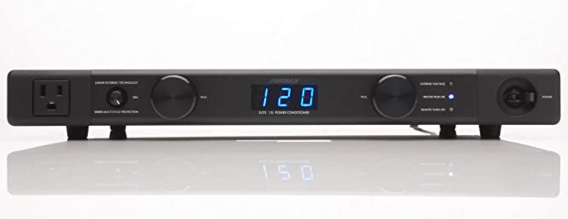
The Furman ELITE15i power conditioner is highly regarded as one of the best offerings from Furman. It boasts the innovative SMP+ (Series Multi-Stage Protection Plus) feature, which provides the highest level of protection for your valuable devices. With SMP+, the ELITE15i ensures that your equipment is safeguarded against surges, spikes, and other power anomalies.
One notable aspect of the ELITE15i is its Power Factor technology, which addresses the power needs of amplifiers. It delivers over 45-amps peak charge surplus current, ensuring that power-starved amplifiers receive the necessary power to perform optimally. This feature is especially beneficial for audio enthusiasts who demand high-performance amplification.
To protect your devices from surges and spikes, the ELITE15i incorporates Furman’s exclusive Multi-Stage Protection (SMP) technology. This advanced system, combined with Extreme Voltage Shutdown (EVS) and Automatic Voltage Monitoring (AVM), provides comprehensive protection against harmful power disturbances. These features ensure that your connected devices are safe from damaging voltage fluctuations.
The ELITE15i’s linear power conditioning feature is designed to deliver clean and filtered AC power to your audio system or home theater. By removing noise and interference from the power supply, it allows your equipment to perform at its best, delivering optimal audio and video quality. This makes the ELITE15i an excellent choice for those seeking an immersive and high-fidelity sound experience.
Ideal for small to moderate-sized home theater systems, the Furman ELITE15i offers exceptional power conditioning to enhance the clarity and performance of your audio and video components. Despite its powerful features, the ELITE15i maintains an attractive and compact design, fitting seamlessly into your setup.
In summary, the Furman ELITE15i power conditioner stands out as one of the top choices from Furman. With its SMP+ technology, Power Factor feature, Multi-Stage Protection, and linear power conditioning, it provides the highest level of protection and performance for your audio and video equipment. Whether you have a small home theater system or a moderate-sized setup, the ELITE15i is a reliable and compact solution that delivers exceptional power management capabilities.
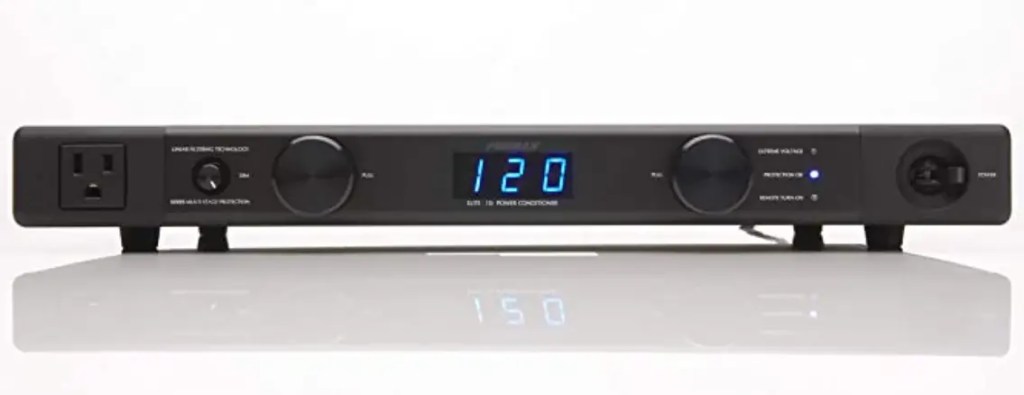
4. Furman M-8Dx Merit X Series 8 Outlet Power Conditioner & Surge Protector
CHECK PRICE ON AMAZON
The Furman M-8DX Merit X Series is another exceptional power conditioner offered by Furman. This conditioner is equipped with an RFI/EMI filtration feature, which effectively reduces noise interference, resulting in a cleaner and more pristine audio signal. This filtration feature helps eliminate unwanted pop, crackles, and radio reception, allowing your audio equipment to perform at its best.
The M-8DX power conditioner boasts nine available outlets, providing ample space to power multiple devices simultaneously. This versatility makes it a convenient choice for users with various audio and video equipment. Additionally, it features a 15A circuit breaker, ensuring that your devices are protected from excessive current draw and potential overloads.
With its surge protection capabilities, the Furman M-8DX keeps your connected AV devices safe and continuously monitored. It safeguards against power spikes and surges, preventing any potential damage that these electrical anomalies may cause. You can have peace of mind knowing that your valuable equipment is well-protected.
The M-8DX power conditioner has a 15-amp rating and is equipped with a circuit breaker to provide reliable electrical protection. The front panel of the device features an indicator LED that illuminates the “Protection OK” sign, assuring users that their system is properly optimized and operating smoothly.
Furthermore, the rear outlets of the M-8DX are designed with accurate spacing, allowing for the accommodation of various types of power adapters, including wall warts. This thoughtful design feature ensures that you can conveniently connect all your devices without any space limitations.
In summary, the Furman M-8DX Merit X Series power conditioner offers outstanding features and protection for your AV equipment. Its RFI/EMI filtration, surge protection, and ample outlet capacity make it a reliable choice. The indicator LED and accurately spaced outlets further enhance the user experience, ensuring optimal performance and ease of use.
5. Panamax MR4000 8-Outlet Home Theatre Power Management
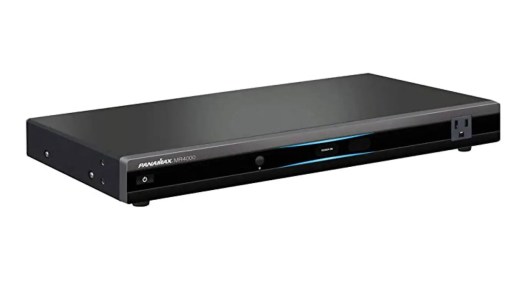
The Panamax 4000 series is widely recognized and highly regarded in the realm of power managers, and the Panamax MR4000 8-outlet home power manager is a popular choice among users. With its 8 power filter outlets (7 in the back and 1 in the front), it provides reliable surge and spike protection for your connected AV devices.
The MR4000 8-Outlet Home Theater Power Management unit features an effective Automatic Voltage Monitoring (AVM) feature. This technology continuously monitors the incoming power and automatically disconnects the connected device in the event of under or over voltage fluctuations. This proactive safeguard ensures that your valuable equipment remains protected from potentially damaging voltage irregularities.
In addition to its AVM capability, the Panamax MR4000 also incorporates a built-in level 2 noise filtration system. This filtration system effectively prevents noise from entering the audio and video signals, providing a clean and uninterrupted AV experience. With this feature, you can enjoy your audio and video content as intended, without any unwanted interference or distortion.
Despite its advanced protection and filtration features, the Panamax MR4000 remains one of the more affordable options in Panamax’s lineup. It offers all the signature and premium protection features that the brand is known for, making it an attractive choice for users seeking reliable power management without breaking the bank.
In conclusion, the Panamax MR4000 8-Outlet Home Theater Power Management unit stands out as a popular choice in the Panamax 4000 series. With its 8 power filter outlets, AVM technology, and built-in noise filtration, it provides comprehensive protection and ensures optimal performance for your AV devices. Despite its affordable price point, it doesn’t compromise on the quality and features that are synonymous with the Panamax brand.
6. AC Power Filter Power Conditioner

The WAudio AC power conditioner series offers a budget-friendly solution for protecting your devices from power surges and spikes. These power managers are designed to automatically detect the ground wire connection of the AC source, ensuring a safe and reliable power supply to your connected devices.
The WAudio power managers are equipped with a combination of 6 sockets of hospital-grade filtered outlets and 4 industrial-grade direct outlets. The filtered outlets provide clean and filtered power, minimizing noise and interference for your audio and video devices. On the other hand, the direct outlets are suitable for devices that require a higher current draw.
An important safety feature of the WAudio power managers is their ability to automatically turn off and disconnect the device when the total current exceeds 15A. This safeguards against overloading and helps protect your equipment from potential damage. To restore power, you simply need to press the RESET button manually.
The WAudio AC Power filter is designed with a removable IEC-type power cord, allowing you the flexibility to upgrade your system with a premium power cable whenever desired. This feature ensures that you can easily enhance your power delivery without having to replace the entire power manager.
If you’re looking for an entry-level power manager with essential functions to power your basic AV devices, the WAudio series is definitely worth considering. It offers reliable surge protection, clean power delivery, and the ability to handle different types of devices with its filtered and direct outlets.
Overall, the WAudio AC power conditioner series provides an affordable option for those seeking surge protection and basic power management features. While it may not offer the advanced functionalities of higher-end models, it serves as a reliable solution to safeguard your devices and improve the overall performance of your audio/video setup.
CHECK PRICE ON AMAZON
7. Panamax M4315-PRO Power Conditioner/Surge Protector 15 Amp
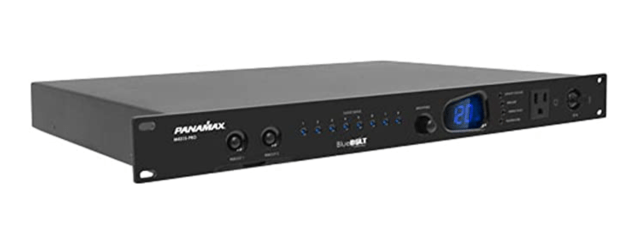
The Panamax M4315-PRO power manager is a feature-packed solution designed to protect your devices from power surges and provide comprehensive power management capabilities. One of its standout features is the inclusion of BlueBOLT technology, which allows for real-time and cloud-based monitoring and control of the power consumed by your connected devices. With BlueBOLT, users can easily perform reboots on devices that may be locked up, as well as monitor energy usage and schedule power conservation.
The M4315-PRO offers a total of 8 fully controllable outlets that can be accessed and managed either through the BlueBOLT platform or via RS-233C outlets. This level of control provides users with the ability to check the status of each outlet directly from the front panel of the unit, ensuring convenient and efficient management of their connected devices. The power manager also features volt/amp meter outlet status and warning LEDs, adding to its premium build and sleek design.
In terms of advanced protection technologies, the Panamax M4315-PRO incorporates two of Panamax’s signature features: Automatic Voltage Monitoring (AVM) circuit and Linear Filtering Technology (LiFT). The AVM circuit constantly monitors the incoming power and reacts promptly in the event of power surges or spikes. This real-time protection helps prolong the lifespan of your connected AV devices by automatically mitigating potential damage caused by voltage irregularities. The LiFT technology further enhances the power conditioning capabilities of the M4315-PRO, providing clean and filtered power to your devices, minimizing noise and ensuring optimal performance.
Overall, the Panamax M4315-PRO power manager combines robust surge protection, comprehensive power management features through BlueBOLT technology, and advanced technologies like AVM and LiFT. Its premium build, sleek design, and convenient outlet control make it an excellent choice for users looking to protect and manage their AV devices effectively.
8. Panamax M8-AV-PRO Hi-Definition 8 Outlet Surge Protector
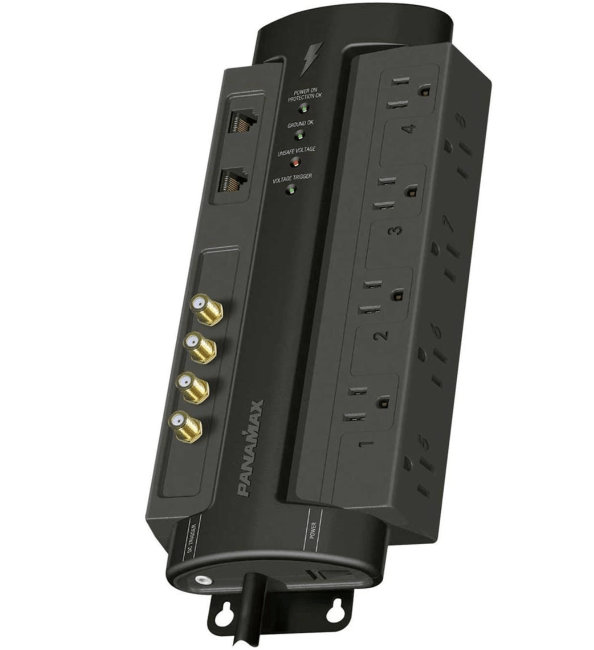
The Panamax M8-AV-PRO Hi-Definition is a highly regarded addition to the premium series of power managers offered by Panamax. It serves as a reliable shield against power surges and fluctuations, safeguarding your connected audio/video devices from potential damage.
The M8-AV-PRO features a total of eight outlets, which are divided into two filter banks with four outlets in each bank. This unique design sets it apart from other power managers on the market. The separation of outlets into two banks serves a specific purpose: minimizing the risk of interference between components. One bank of outlets is dedicated to protecting devices that require higher current, such as power subwoofers and home theater systems, among others. This ensures that these power-hungry devices receive the necessary power without impacting the performance of other connected equipment. The other bank of outlets is reserved for the remaining devices, providing them with filtered power for optimal performance.
One notable feature of the Panamax M8-AV-PRO is its Automatic Voltage Monitoring (AVM) capability. In the event of a power surge or irregular voltage spike, the AVM system reacts swiftly by disconnecting the power supply to your device in less than a nanosecond. This rapid response helps prevent any potential damage to your valuable equipment. Once the AC voltage returns to normal levels, the M8-AV-PRO automatically reconnects the power to the device, ensuring seamless operation without the need for manual intervention.
Overall, the Panamax M8-AV-PRO Hi-Definition power manager offers exceptional protection and performance for your audio/video setup. Its specialized outlet configuration, with separate filter banks, mitigates interference and optimizes power distribution. With the added Automatic Voltage Monitoring feature, you can have peace of mind knowing that your devices are shielded from power fluctuations. The M8-AV-PRO is a reliable choice for anyone seeking a premium power management solution to safeguard their valuable audio/video equipment.
9. AudioQuest PowerQuest 3 – Power Conditioner
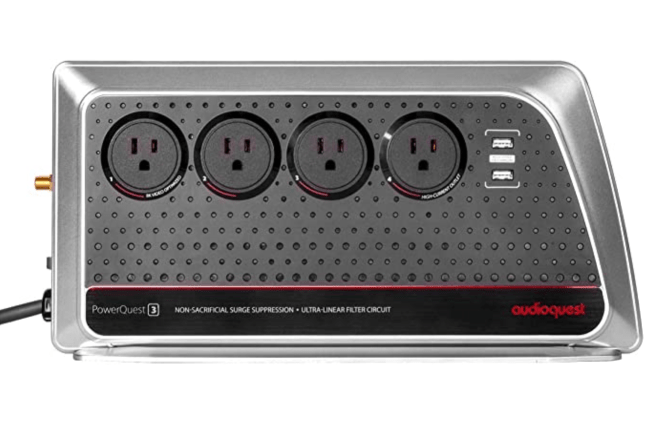
The AudioQuest PowerQuest 3 is a power conditioner designed to provide surge protection and reliable power distribution for a wide range of audio/video devices. It boasts 8 outlets that are strategically allocated to cater to different equipment requirements. Among these outlets, there are 2 specifically designated for 4K/8K video devices, 2 for high-current devices, and 4 for ultra-linear filtered devices.
One of the standout features of the PowerQuest 3 is its noise dissipation system, which is an improvement over its predecessor, the PowerQuest 2. This advanced system is capable of effectively reducing sound by more than 22 decibels, ensuring a clean and interference-free power supply to your audio and video equipment.
With its extreme voltage shutdown threshold of 140VAC, the PowerQuest 3 offers robust protection against power fluctuations. In the event of a voltage surge that exceeds the safe threshold, the power conditioner swiftly responds by opening the main power circuit relay in less than 0.25 seconds. Once the power returns to a safe range, the PowerQuest 3 automatically resets the power supply to the connected devices, ensuring their uninterrupted operation.
The PowerQuest 3 also includes 2 outlets dedicated to 4K and 8K devices. This feature is particularly beneficial for users who have high-resolution televisions, as it enables them to enjoy a seamless viewing experience without any artifacts or visual disturbances. Additionally, the power conditioner offers the convenience of 4 USB charge ports, allowing users to conveniently charge their devices while maintaining a clutter-free setup.
Overall, the AudioQuest PowerQuest 3 power conditioner stands as a reliable solution for protecting your audio and video equipment against power surges and ensuring clean power delivery. With its specialized outlet allocation, noise dissipation system, extreme voltage shutdown threshold, and support for 4K/8K devices, it provides a comprehensive power management solution for a variety of home theater setups and audio/video systems.
10. Soundavo PMX-3300 Power Conditioner
CHECK PRICE ON AMAZON
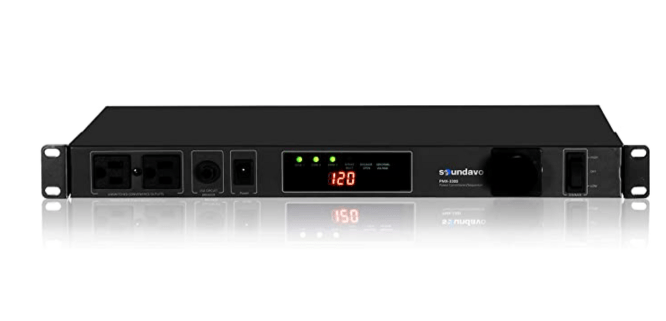
The PMX-3300, manufactured by Soundavo, is a remarkable power conditioner and sequencer that offers excellent performance at a budget-friendly price point. Designed with a focus on stability, it features a multi-stage noise-filtering capability that effectively minimizes the interference of RFI (Radio Frequency Interference) and EMI (Electromagnetic Interference), ensuring a consistent and clean power supply to your system.
One of the notable features of the PMX-3300 is its eight delayed outlet groups. These outlets are divided into three categories: three outlets for digital filtered devices, three outlets for analog filtered devices, and two outlets for high-power filters from Zone 1 to Zone 3. This arrangement is particularly convenient for various applications such as home audio setups, instrument rigs, sound recording studios, or professional audio/DJ equipment that utilize power amplifiers, active speakers, and preamp/mixer configurations.
The PMX-3300 offers a reverse sequence power-off functionality for the different zones. This means that when powering off the unit, the zones are deactivated in a reverse order, providing an added level of convenience and flexibility in managing your devices.
To further enhance the power conditioning capabilities, the PMX-3300 incorporates RFI filtering with a multi-stage PL (Power Line) filter. This feature significantly reduces the noise typically caused by dirty AC power, ensuring a cleaner and more reliable power supply to your audio or video devices.
Additionally, the PMX-3300 includes a front panel dimmer switch. This allows users to adjust the brightness of the panel according to their preference or specific lighting conditions, providing a customizable user experience.
Overall, the PMX-3300 power conditioner and sequencer from Soundavo is an impressive choice for those seeking a cost-effective solution that delivers stable power and effectively mitigates noise interference. Its versatile outlet groups, reverse sequence power-off functionality, RFI filtering, and adjustable panel brightness make it a highly recommended option for home audio enthusiasts, recording studios, and professional audio setups.
CHECK PRICE ON AMAZON
Power Manager Comparison Table
The table below summarizes the ten units reviewed above so you can compare them on outlet count, isolation banks, voltage regulation, and price tier at a glance.
| Model | Outlets | Isolation Banks | Voltage Regulation (AVM/EVS) | USB / Signal Protection | Price Tier | Best For |
|---|---|---|---|---|---|---|
| Panamax MR4300 | 9 | 2 isolated linear filtered + 2 high-current | Yes — AVM + Protect or Disconnect | USB, coax, LAN, telco | Mid-range | Balanced protection with signal filtering |
| Panamax M5400-PM | 11 | Multiple banks + 2 switched high-current | Yes — AVM + Level 4+ filtration | USB, LAN | Premium | Large home theatres with 12V trigger needs |
| Furman ELITE15i | 15A rated | Linear Filtering (LiFT) | Yes — SMP+ + EVS + AVM | None built in | Premium | Power-starved amplifiers needing peak current |
| Furman M-8Dx Merit X | 9 | Single bank with RFI/EMI filtration | No AVM | None built in | Budget | Basic protection for small systems |
| Panamax MR4000 | 8 | Single bank, Level 2 noise filtration | Yes — AVM | None built in | Mid-range | Entry-level home theatres with voltage protection |
| WAudio AC Power Filter | 10 | 6 filtered + 4 direct | Auto-disconnect above 15A | None built in | Budget | Budget installs and secondary systems |
| Panamax M4315-PRO | 8 | Fully controllable + isolated banks | Yes — AVM + LiFT | LAN (BlueBOLT) | Premium | Smart-home integration and remote reboot |
| Panamax M8-AV-PRO | 8 | 2 isolated filter banks (4 each) | Yes — AVM in under 1 nanosecond | Coax, 12V trigger | Premium | Home theatres with powered subs and projectors |
| AudioQuest PowerQuest 3 | 8 | 4 dedicated banks (4K/8K, high-current, ultra-linear) | Yes — 140VAC shutdown in under 0.25s | 4 USB ports | Mid-range | 4K/8K TVs and streaming setups |
| Soundavo PMX-3300 | 8 | 3 zones (digital, analog, high-power) | No AVM | None built in | Budget | Sequenced power-up for studios and A/V racks |
Power Manager Maintenance and Testing
A power manager is not a fit-and-forget device. Like the equipment it protects, it needs occasional attention to keep working correctly.
Monthly Checks
- Check the indicator LEDs. Most premium units have a “Protection OK” or “Wiring OK” LED that should stay illuminated. If it goes dark, the protection circuit has been depleted or the outlet is miswired.
- Verify the voltage readout (if the unit has one) is in the normal range — typically 115V to 125V in North America, 220V to 240V in Europe and much of Asia.
- Listen for buzzing. A power manager that hums audibly is usually suffering from a failing transformer or a loose internal connection. Both warrant service.
- Check that switched outlets respond to the front-panel switch or remote trigger.
Annual Checks
- Inspect the power cord and plug for fraying, discoloration, or heat marks. Replace the unit if the cord is damaged.
- Vacuum the vents. Dust buildup reduces airflow and can cause the unit to overheat, especially in enclosed cabinets.
- Re-seat every plug. Plugs that work loose over time can arc and cause intermittent connections. Push each one firmly back into its outlet.
- Replace the unit after a major surge. If a thunderstorm or utility event has triggered the protection circuit, assume the MOVs absorbed significant energy. Units with a protection-status LED will show when the protection is depleted; replace the unit rather than continue using it.
When to Test the Protection Circuit
Many premium units include a test button or an automatic self-test that confirms the protection circuit will trigger at the rated clamping voltage. If your unit has a test feature, use it twice a year. If it does not, the safest approach is to replace the unit every five to seven years in areas with unstable power, or every seven to ten years in areas with stable power.
Repair or Replace a Power Manager?
When a power manager stops working, the decision usually comes down to the unit’s price tier and the severity of the fault. Most repairs cost more than a new budget unit, but a premium unit is often worth servicing.
| Situation | Repair | Replace |
|---|---|---|
| Under warranty | Yes — contact the manufacturer | No |
| Premium unit under 5 years old | Usually worth it if the quote is under half the new price | Only if the repair cost exceeds half the new price |
| Budget unit under $150 | Rarely worth it — most repairs cost more than a new unit | Yes |
| Protection circuit depleted | Not typically repairable at reasonable cost | Yes — the MOVs have done their job |
| Buzzing or humming from the unit | Worth diagnosing on premium units | On budget units, usually not worth it |
| Physical damage from a surge (burn marks, smell) | Only if the unit is a high-value model | Yes in most cases |
| Display or LED failure, unit otherwise works | Optional — cosmetic in most cases | Only if the display controls operation |
Home Theatre Power Glossary
| Term | Meaning |
|---|---|
| AVM (Automatic Voltage Monitoring) | A circuit that watches incoming voltage and disconnects power when it goes out of a safe range |
| EVS (Extreme Voltage Shutdown) | A Furman/Panamax circuit that shuts the unit off entirely when voltage reaches dangerously high or low levels |
| LiFT (Linear Filtering Technology) | A noise-filtering design used by Furman to provide consistent attenuation across the audio frequency range |
| MOV (Metal Oxide Varistor) | The component inside a surge protector that diverts excess voltage to ground |
| Clamping Voltage | The voltage at which the surge protector begins diverting excess energy; lower is better |
| Joule Rating | The total energy a surge protector can absorb before it stops protecting |
| Isolation Bank | A group of outlets filtered and protected independently from other groups on the same unit |
| High-Current Outlet | An outlet designed for amplifiers and subwoofers that draw large current on demand |
| Always-On Outlet | An outlet that stays powered regardless of the front-panel switch, used for routers and DVRs |
| Switched Outlet | An outlet controlled by the unit’s front-panel switch or a remote trigger |
| 12V Trigger | A low-voltage control signal that turns connected devices on and off together |
| Dirty Power | AC power that contains noise, harmonics, or voltage irregularities that can degrade audio and video performance |
| Voltage Sag | A temporary drop in line voltage, often caused by heavy loads on the same circuit |
| Surge | A brief spike in voltage above the normal level, usually caused by lightning, utility switching, or heavy appliances |
Frequently Asked Questions
Do I really need a power manager for my home theatre?
If your home theatre equipment is worth more than $1,000, yes. A power manager protects against two things a standard surge protector does not: electrical noise that degrades audio and video quality, and voltage irregularities that can damage sensitive electronics. For a basic TV and soundbar setup, a quality surge protector is adequate. For a system with a receiver, subwoofer, projector, and multiple sources, a power manager is worth the investment.
What is the difference between a power conditioner and a surge protector?
A surge protector diverts excess voltage to ground during a spike. A power conditioner does that and also filters electrical noise and (on premium models) regulates the incoming voltage. A power conditioner is a superset of a surge protector.
Are expensive power conditioners worth it?
For mid-range and premium home theatres, yes. The isolation banks and voltage regulation in a $300–$800 conditioner are measurably better than a $50 power strip. For an entry-level system with a TV and soundbar under $1,000 total, a quality $50–$100 surge protector is often enough and the extra features of a premium conditioner will not be audible.
How many joules do I need for a home theatre?
1,000 joules is the minimum for a basic setup. 2,000 joules is a sensible target for a mid-range home theatre. 4,000 joules or more is appropriate for a premium system with a projector, separate amplifiers, and a powered subwoofer. Higher joule ratings absorb more energy before the unit stops protecting.
What is a good clamping voltage?
330V or lower. Clamping voltage is the level at which the protector begins diverting excess energy. Lower is better because the protector acts sooner, exposing your equipment to less voltage. Anything above 400V is not suitable for sensitive AV gear.
Does a power conditioner improve sound quality?
In systems with noticeable background noise from dirty AC power, yes. Removing electrical noise from the power supply reduces the noise floor and can make dialogue and quiet passages clearer. In systems where the incoming power is already clean, the improvement is subtle and often inaudible.
Can I plug a power conditioner into a surge protector?
Do not plug a power conditioner into a surge protector, or a surge protector into a power conditioner. Both are designed to be plugged directly into a wall outlet. Daisy-chaining defeats the clamping voltage and impedance characteristics both units were designed around, and can even be a fire hazard.
Can I plug a power conditioner into an extension cord?
Only a heavy-gauge extension cord rated for the current draw, and only as a temporary solution. A 14-gauge or heavier extension cord of no more than 25 feet is acceptable in an emergency. For a permanent installation, the power manager should be plugged directly into a wall outlet on a dedicated circuit.
Will a power conditioner protect against lightning?
A power conditioner will protect against most indirect lightning surges that reach the outlet, but no plug-in device can protect against a direct lightning strike. For whole-home lightning protection, you need a licensed electrician to install a whole-panel surge protector at the main electrical panel, combined with point-of-use protectors like the ones in this guide.
Do power conditioners consume electricity?
They consume a small amount — typically 1 to 5 watts in standby. That is less than a night light. The consumption is not significant compared to the protection they provide.
How often should I replace a power conditioner?
Every five to seven years in areas with frequent thunderstorms or unstable power, and every seven to ten years in areas with stable power. Replace it immediately if the “Protection OK” LED has gone dark or if the unit has absorbed a major surge.
What is an isolation bank and why does it matter?
An isolation bank is a group of outlets filtered and protected independently from the other outlets on the same unit. Isolation banks prevent noise from one type of device — for example, a switching router — from contaminating the power supply of another device — for example, a preamplifier. Units with multiple isolation banks cost more and produce measurably cleaner sound in high-end systems.
Are Panamax and Furman both good brands?
Yes. Both are among the most respected names in home theatre power management. Panamax is known for its BlueBOLT remote monitoring and its Protect or Disconnect feature. Furman is known for its LiFT filtering, SMP+ protection, and power factor technology for amplifiers. For most buyers, either brand will provide excellent protection and the choice comes down to specific features.
Can I use a power conditioner with a powered subwoofer?
Yes, and it is recommended. A powered subwoofer draws high current on bass peaks and benefits from a high-current outlet that can supply the transient demand without voltage sag. Look for a power manager with at least one high-current outlet when you have a powered sub in your system.
Do power managers help with hum?
Sometimes. A power conditioner can eliminate hum caused by electrical noise on the AC line, but it will not fix a ground loop between two devices — that requires plugging the offending devices into the same power strip or using a ground loop isolator. If the hum is a ground loop, a power manager will not solve it on its own.
What is the difference between a power conditioner and a UPS?
A power conditioner filters noise and protects against surges and voltage irregularities. A UPS (uninterruptible power supply) contains a battery that keeps your equipment running during a power outage. They serve different purposes. A UPS with built-in power conditioning is the most comprehensive option, but it costs considerably more than a standalone power conditioner.
Does a power conditioner affect video quality?
On systems with visible video noise — flickering, on-screen artifacts, or HDMI handshake issues — a power conditioner with dedicated video outlets can reduce or eliminate these problems by providing cleaner power to the source devices. On clean systems, the improvement is not visible.
Can a power conditioner cause hum?
Rarely, but it does happen. A power conditioner with a failing transformer or a ground loop within the unit can introduce hum rather than eliminate it. If a new conditioner introduces hum that was not present before, unplug it and either return it or have it inspected by the manufacturer.
Final Thoughts
Having power managers is a must to safeguard your audio and video gadgets against power surges, ultimately prolonging their life span while optimizing performance. The market has an array of conditioners or managers that are quite appealing; thus, choosing any would be rewarding in the long run. However, taking certain considerations mentioned earlier into account before making up one’s mind helps ascertain which option fits best as per individual budget constraints & expense on prevailing home theater equipment setup requirements – determining whether either just basic surge protection will suffice or if more substantial vigilance with employing a power manager makes rational sense for future security measures.
Before making a purchase decision, it is crucial to ask yourself important questions. We strongly advise investing in a home theater power manager as an essential piece of technology that provides exceptional protection for your valuable devices without breaking the bank. After putting significant effort into building an ideal home setup with top-quality subwoofers, premium speakers and screens having clear displays; ensuring their maintenance and safeguarding from undesired occurrences like sudden drops or surges becomes critical.