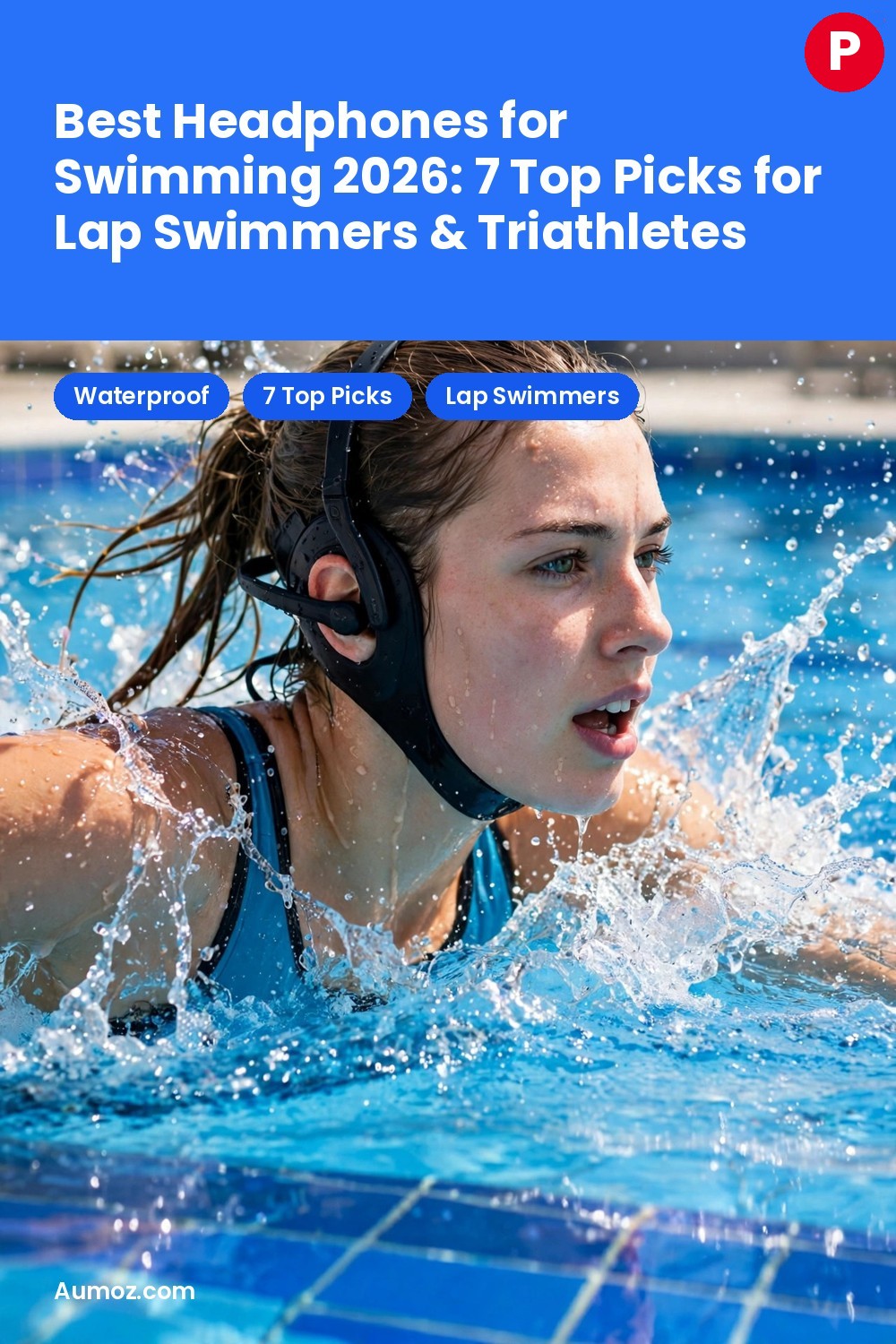

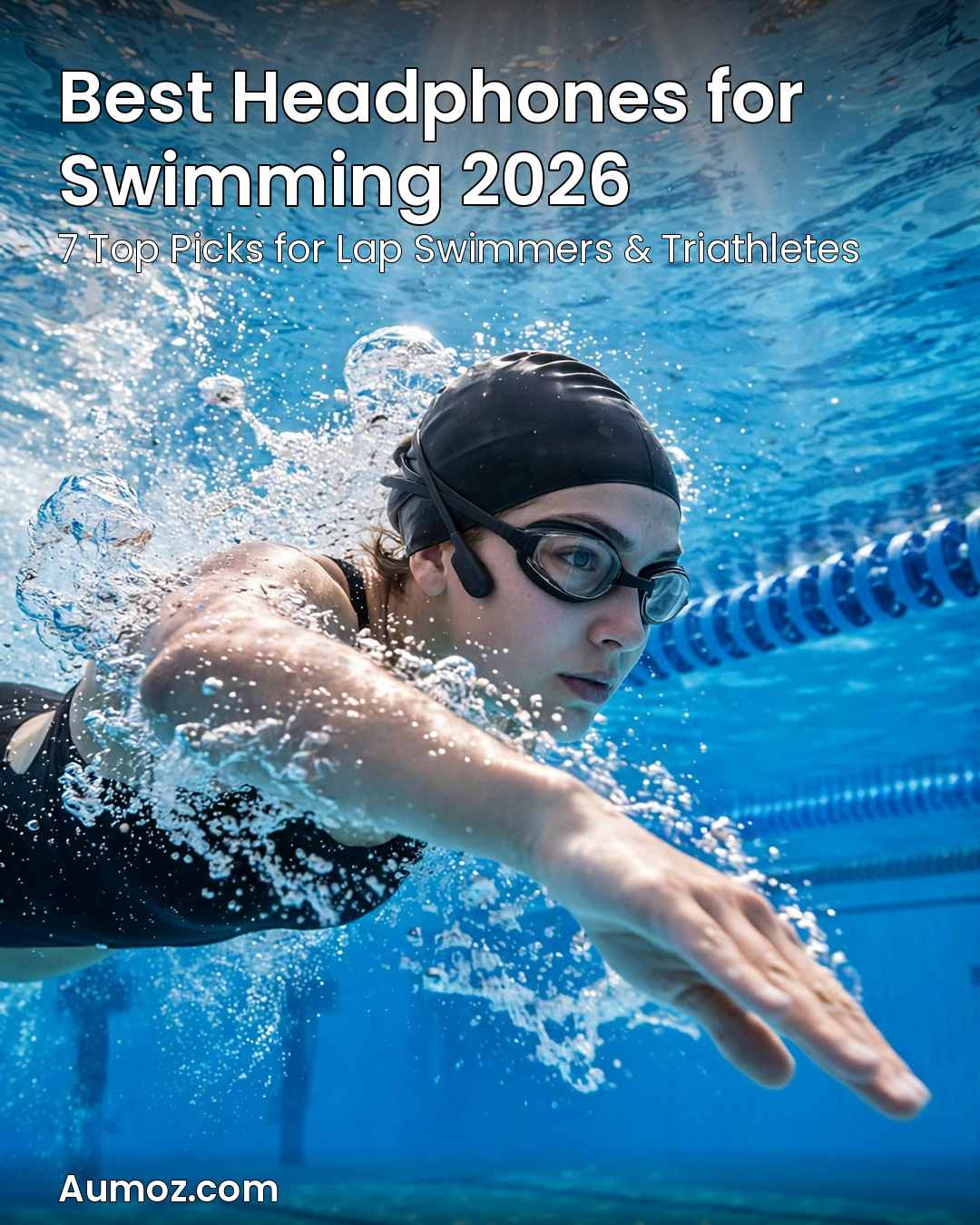
Best Headphones for Swimming 2026: 7 Top Picks for Lap Swimmers & Triathletes
The best headphones for swimming let you listen to music, podcasts, and audiobooks through every lap — without a wire, without a phone on the pool deck, and without killing your earbuds on the first submersion. That last part is the hard one: most “water-resistant” earbuds are built for sweat and rain, not for being underwater for an hour at a time.
Swimming headphones are a different product category from gym headphones. They need a true waterproof rating (IPX8 or IP68), built-in music storage — because Bluetooth does not work underwater — and a fit that survives flip turns, dive starts, and a swim cap. We compared the seven best headphones for swimming in 2026 across the things that actually matter in the pool: waterproof depth, storage, battery life, fit under a cap, and price.
Prices below are typical US list prices at the time of writing and move often, so check the current price before you buy. And one warning up front: if you already own AirPods, do not swim in them — they are splash-resistant, not waterproof, and Apple does not cover water damage under warranty.
Best Headphones for Swimming 2026 at a Glance
| Headphones | Best For | Waterproof Rating | Music Storage | Battery | Price (approx.) |
|---|---|---|---|---|---|
| Shokz OpenSwim Pro | Best overall | IP68 (2 m / 2 h) | 32 GB MP3 | 9 hours | ~$180 |
| Shokz OpenSwim | Best value bone conduction | IP68 (2 m / 2 h) | 4 GB MP3 | 8 hours | ~$80 |
| FINIS Duo | Best sound quality | IPX8 (3 m) | 4 GB MP3 | 7 hours | ~$120 |
| Swimbuds Sport | Best in-ear waterproof | IPX8 (3 m) | MP3 player (wired) | 8 hours | ~$70 |
| JBL Endurance Peak 3 | Best for swimming + running | IP68 | Bluetooth (no MP3) | 10 h (50 h with case) | ~$100 |
| PSIER X34-C | Best budget bone conduction | IPX8 (2 m) | 32 GB MP3 | 8 hours | ~$50 |
| Tayogo W16 | Best ultra-budget MP3 | IPX8 (3 m) | 8 GB MP3 | 20 hours | ~$30 |
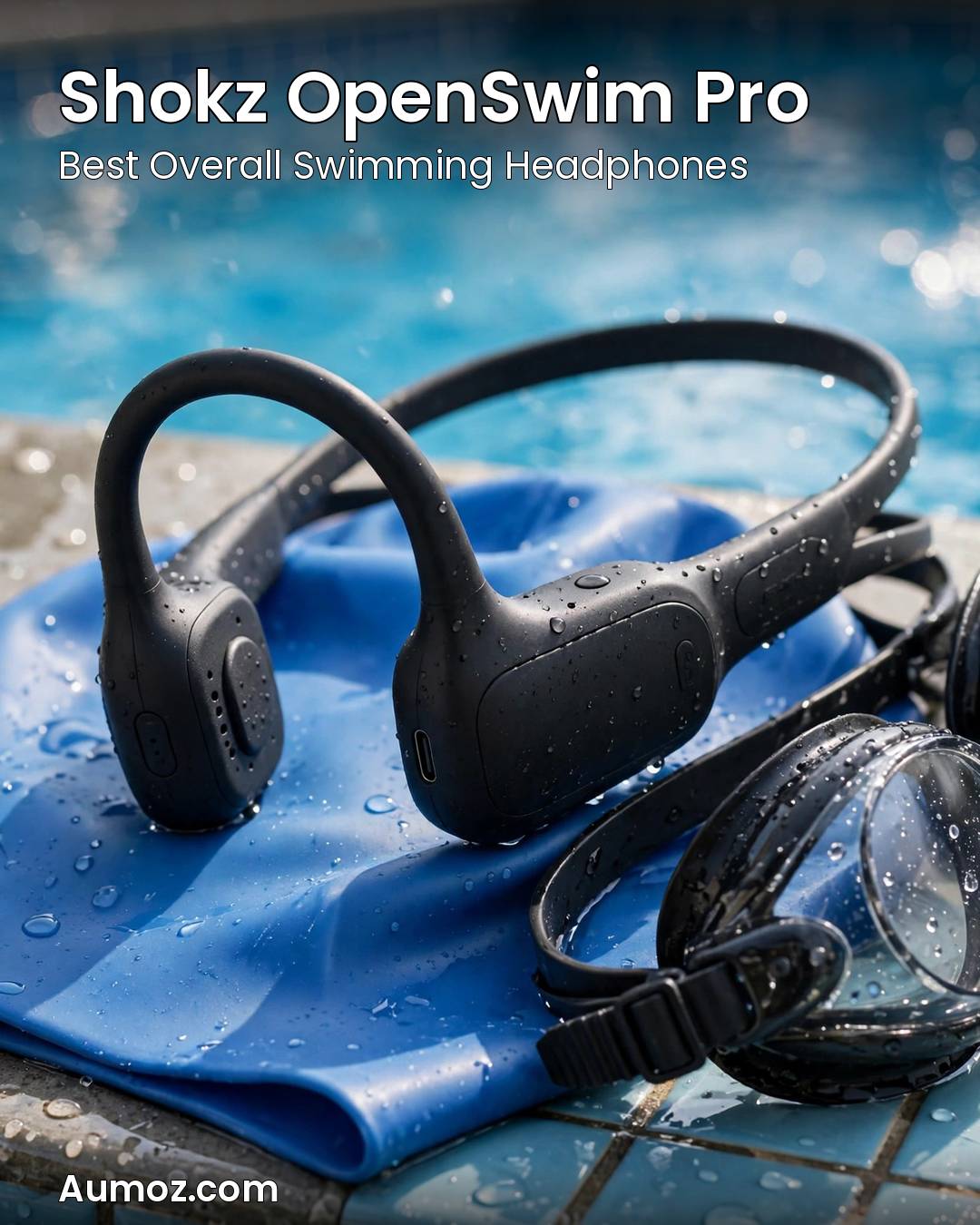
1. Shokz OpenSwim Pro — Best Overall
The Shokz OpenSwim Pro is the best headphone for swimming for most people in 2026, and it wins the same way in almost every roundup we checked: it is the only pick here that is genuinely great both in the pool and on dry land. Bone conduction sends sound through your cheekbones, so your ears stay open — you can hear the lifeguard, your coach, or a lane mate — and nothing sits inside your ear canal to trap water.
It is rated IP68, submersible to 2 metres for up to 2 hours, and carries 32 GB of built-in MP3 storage — enough for roughly 8,000 songs — plus Bluetooth 5.4 for use out of the water. Battery life is 9 hours per charge, and a 10-minute quick charge gives about 2 hours of playback. At around $180 it is the most expensive pick here, but it is also the only one that can replace your running headphones too: use MP3 mode in the pool, Bluetooth mode on the run.
Who should buy it: lap swimmers and triathletes who want one pair for pool and land, and anyone who dislikes earbuds sitting inside a wet ear canal.
2. Shokz OpenSwim — Best Value Bone Conduction
The original Shokz OpenSwim is the OpenSwim Pro’s cheaper sibling, and for pure pool use it is almost as good. Same IP68 rating, same open-ear bone conduction design, same 2-metre depth rating — the differences are 4 GB of storage instead of 32 GB, Bluetooth 5.1 instead of 5.4, and 8 hours of battery instead of 9.
Four gigabytes still holds around 1,000 songs, which is more than enough for a month of swim sessions before you need to reload. At around $80 — less than half the Pro’s price — it is the best value swimming headphone on this list if you swim a few times a week and do not need the Pro’s bigger storage or quick charge.
Who should buy it: regular lap swimmers on a budget, and first-time swim-headphone buyers who want the proven Shokz design without the flagship price.
3. FINIS Duo — Best Sound Quality
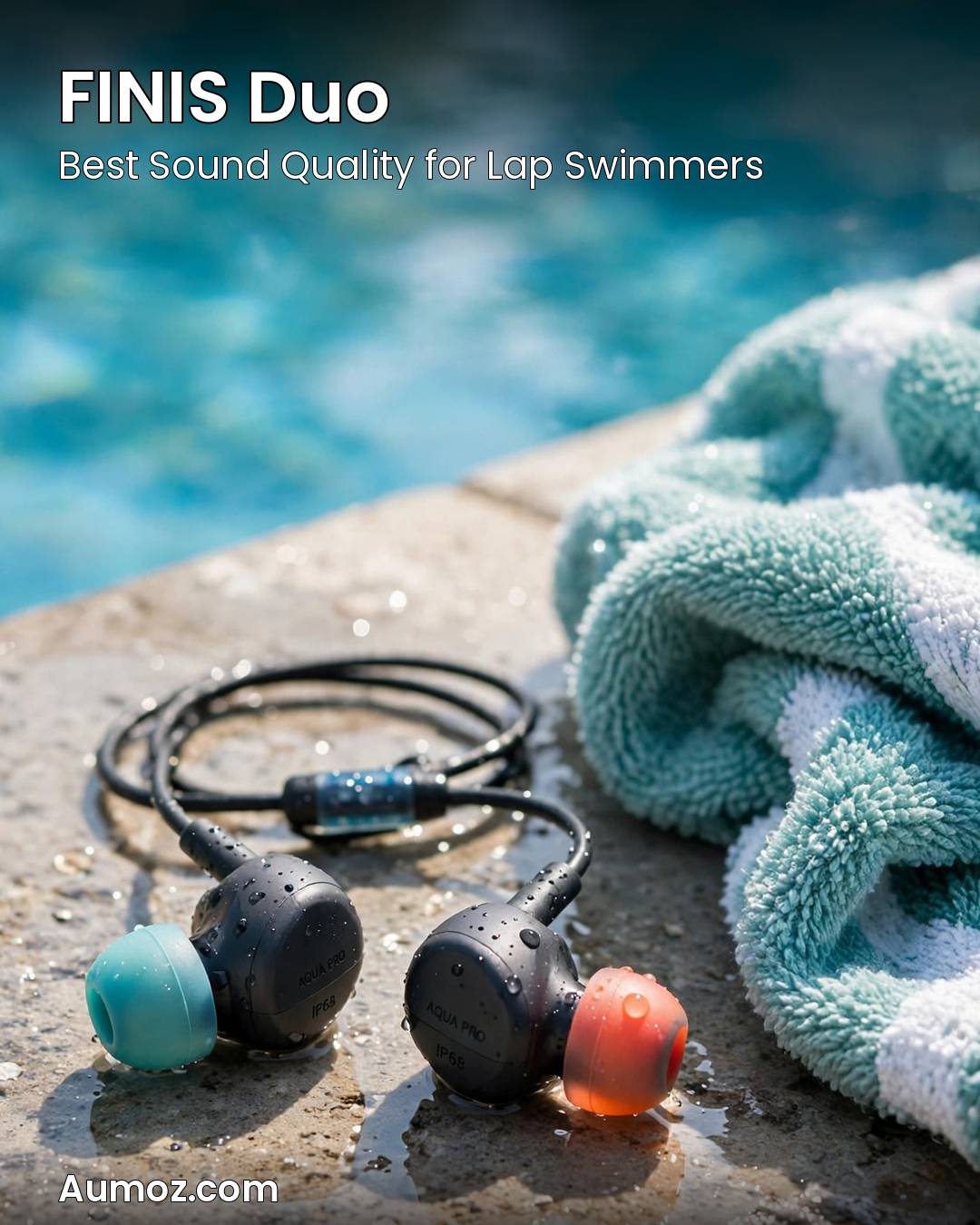
The FINIS Duo is the swimming specialist’s pick. FINIS has made professional swim gear for decades, and the Duo is built around one idea: bone conduction sound is noticeably better underwater than in air, because the water itself helps carry the vibration. Reviewers consistently rate the Duo’s underwater sound quality above the Shokz models — clearer highs, fuller bass — and its clip design sits on the cheekbones and under the goggle strap without shifting during flip turns.
It is rated IPX8 to 3 metres, stores 4 GB of MP3 audio (about 1,000 songs), and runs for around 7 hours per charge. There is no Bluetooth at all — this is a dedicated swim MP3 player, not a dual-purpose headphone. At around $120 it sits between the two Shokz models on price, and for sound quality alone it is the best headphone for swimming on this list.
Who should buy it: serious lap swimmers and competitive swimmers who care more about sound quality in the water than about using the same pair on land.
4. Swimbuds Sport — Best In-Ear Waterproof Headphones
Not everyone likes bone conduction. If you want traditional in-ear sound — a sealed ear canal, real bass, and noise isolation from the pool’s echo — the Swimbuds Sport is the best in-ear swimming headphone we found. It is rated IPX8 to 3 metres, ships with four types of earbuds so you can find a watertight seal, and uses a short cord that clips to your goggles so the buds cannot drift away mid-lap.
The trade-off is that the Swimbuds Sport is a wired MP3 setup: the buds connect to a small waterproof MP3 player (sold with the bundle) rather than streaming from your phone, because Bluetooth cannot reach underwater. Sound quality is excellent once the seal is right — but getting that seal right takes patience, and a bad fit means muffled audio and water in the ear. Try all four included tip styles before your first proper swim.
Who should buy it: swimmers who want sealed in-ear sound and strong bass, and anyone who finds bone conduction too quiet or too unusual.
5. JBL Endurance Peak 3 — Best for Swimming + Running
The JBL Endurance Peak 3 is the crossover pick. With an IP68 rating, an ear-hook design that stays put through sprints, and up to 10 hours per charge (50 hours with the case), it is built for athletes who train in and out of the water. The sound is classic JBL: punchy, bass-forward, and loud enough to cut through pool noise on deck.
Be honest about one limitation: the Endurance Peak 3 has no built-in MP3 storage, so it streams over Bluetooth — which means it works on the pool deck, on the run, and in the gym, but not underwater with your head submerged. If your swimming is mostly water aerobics, aqua jogging, or pool-deck workouts with your head above water, it is superb. If you swim laps face-down, pick one of the MP3 models above instead. For dry-land training, see our guide to the best open-ear earbuds for running.
Who should buy it: triathletes and multi-sport athletes who want one pair for the run, the gym, and the pool deck — and who do most of their swimming with their head out of the water.
6. PSIER X34-C — Best Budget Bone Conduction
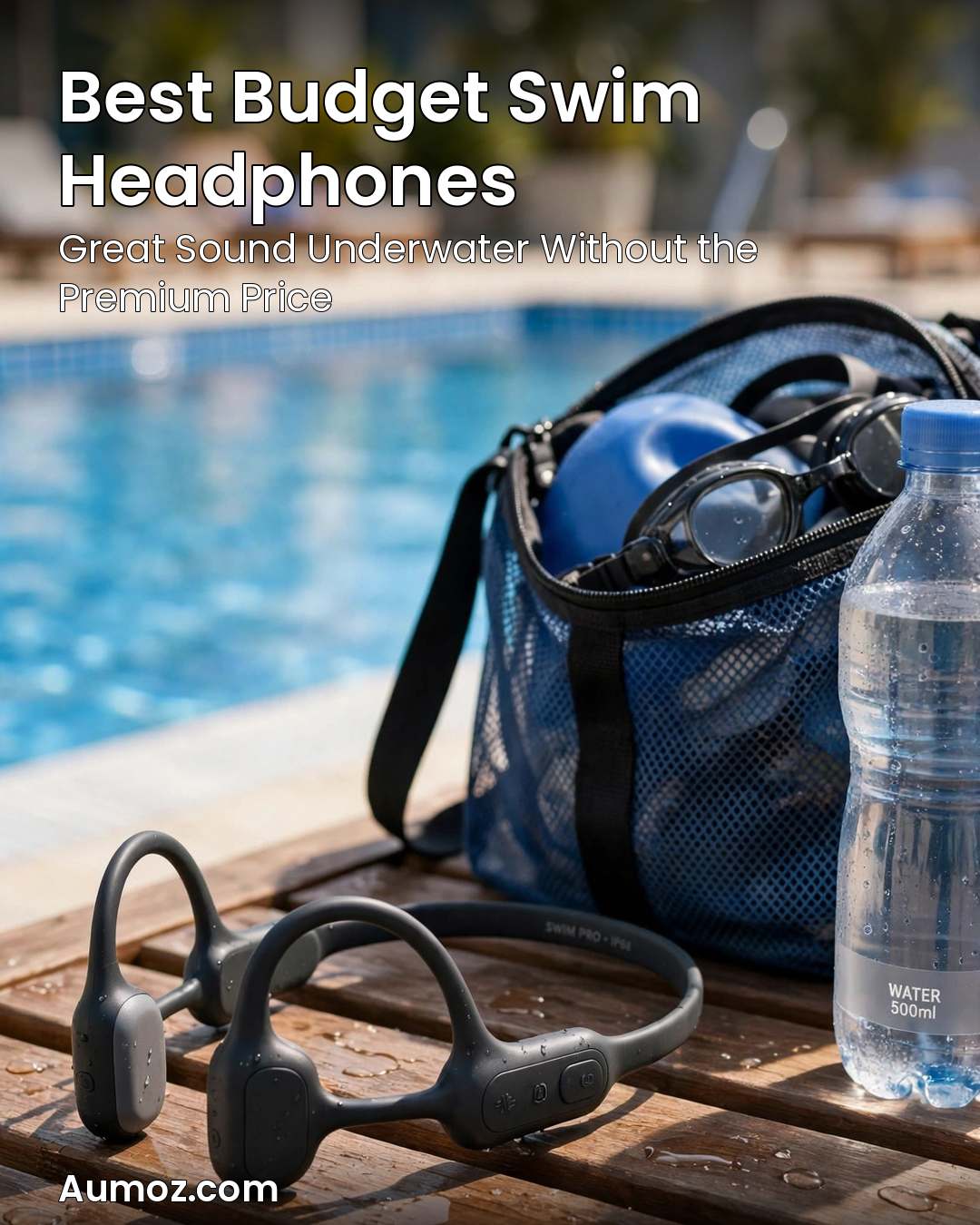
The PSIER X34-C proves you do not need to spend $180 to swim with music. For around $50 you get a hybrid bone-and-air conduction design, an IPX8 rating to 2 metres, 32 GB of built-in MP3 storage — the same capacity as the flagship Shokz OpenSwim Pro — and around 8 hours of battery per charge.
Build quality and app support are not in the same league as Shokz, and the sound is a step behind the FINIS Duo, but for the price the X34-C is remarkably complete: it is fully submersible, it stores its own music, and it fits under a swim cap. It is the pick we recommend most often to swimmers who are not sure they will use swim headphones enough to justify a premium pair.
Who should buy it: budget buyers, beginners, and anyone testing whether swimming with music is for them before spending more.
7. Tayogo W16 — Best Ultra-Budget MP3 Swim Headphones
The Tayogo W16 is the cheapest genuinely swim-safe headphone on this list, at around $30. It is a dedicated waterproof MP3 player headset rated IPX8 to 3 metres, with 8 GB of storage (roughly 2,000 songs) and an impressive 20 hours of playback per charge — the longest battery life here.
There is no Bluetooth and no app, and the silicone-coated design is functional rather than beautiful. But it does the one job that matters: it plays your music underwater, lap after lap, for less than the cost of a month’s pool membership. For kids’ swim training, school swim teams, or a spare pair you will not cry over if it gets lost at the beach, it is hard to beat.
Who should buy it: ultra-budget buyers, swim coaches buying for a team, and anyone who wants a simple, tough, dedicated swim player.
Why Bluetooth Does Not Work Underwater
This is the single most important thing to understand before buying swimming headphones. Bluetooth uses 2.4 GHz radio waves, and water absorbs those waves almost completely — the signal dies within a few centimetres of the surface. That is not a flaw in your earbuds; it is physics. The moment your head goes under, a Bluetooth-only earbud loses its connection to your phone, and the music stops.
That is why every true swimming headphone on this list — except the JBL, which is a crossover pick — carries its own music storage. You load MP3 files onto the headphones themselves (usually by USB drag-and-drop), and the player inside the headphones does the work. No phone, no signal, no dropouts. It is also why “waterproof” alone is not enough: a waterproof Bluetooth earbud with no storage is still useless underwater. When you shop, look for two things together — an IPX8 or IP68 rating and built-in MP3 storage.
IP Ratings Explained: IPX7 vs IPX8 vs IP68
Waterproof ratings are defined by the international IP Code standard, and the numbers are not marketing fluff — they describe tested submersion. Here is what matters for swimming:
- IPX4: splash-resistant only. Fine for sweat and rain; never swim in it. This is what AirPods and most gym earbuds carry.
- IPX5: resistant to low-pressure water jets. Showers and heavy rain, not swimming.
- IPX7: survives immersion to 1 metre for 30 minutes. An accidental drop in the pool, not lap swimming.
- IPX8: continuous immersion beyond 1 metre, to a depth and time the manufacturer specifies — typically 2–3 metres. This is the minimum for swimming.
- IP68: dust-tight (the “6”) plus continuous immersion beyond 1 metre (the “8”). The best rating for swim headphones.
Two warnings. First, IP tests are done in fresh water under lab conditions — repeated chlorine or saltwater exposure can erode seals over time, so rinse your headphones in fresh water after every swim. Second, water resistance is not permanent: drops, heat, and age degrade seals, so check your pair’s condition each season. You can read the full standard on the IP Code explained by Wikipedia.
How to Choose the Best Headphones for Swimming
1. Pick your sound style: bone conduction or in-ear
Bone conduction (Shokz, FINIS, PSIER) keeps your ears open, so you hear the lifeguard and your coach, and water never gets trapped in the canal. Sound is thinner, especially bass. In-ear (Swimbuds) seals the canal for fuller sound and isolation, but the fit must be perfect or water leaks in and the audio goes muffled. If you have ever had swimmer’s ear, bone conduction is the safer choice.
2. Demand IPX8 or IP68 — and MP3 storage
These two features together are non-negotiable for lap swimming. IPX7 or lower is not enough, and a Bluetooth-only pair — however waterproof — will go silent the moment your head submerges. The only exception is if you train with your head out of the water, in which case the JBL Endurance Peak 3 is a fine crossover pick.
3. Check the fit under a swim cap and goggles
Swim headphones sit in a crowded space: cap, goggle strap, and headphone band all compete for the same real estate. Bone conduction bands route behind the head and generally fit under a cap; in-ear buds with a short cord clip to the goggle strap. Try your setup at home before your first session — a headphone that slips during a flip turn is worse than no music at all.
4. Match battery to your training week
Seven to nine hours covers a week of daily hour-long swims for most of the picks here; the Tayogo W16’s 20 hours covers a fortnight. Quick charge matters more than the headline number: the OpenSwim Pro’s 10-minute top-up for 2 hours of playback has saved many sessions.
5. Budget honestly — and protect the pair
Flagship swim headphones cost $120–$180; the sweet spot is $50–$80, where the Shokz OpenSwim and PSIER X34-C deliver nearly everything the flagships do. Whatever you buy, rinse it in fresh water after every swim, dry it before charging, and never charge a wet pair — chlorine and salt are what kill swim headphones, not the water itself. If you also train on land, our guide to the best over-ear gym headphones for working out covers sweat-proof options for the gym.
Best Headphones for Swimming 2026 — Our Verdict
For most swimmers, the Shokz OpenSwim Pro is the best headphone for swimming in 2026: IP68 waterproofing, 32 GB of MP3 storage, Bluetooth for dry land, and a fit that survives flip turns. If sound quality in the water is your top priority, get the FINIS Duo. If your budget tops out under $100, the Shokz OpenSwim or the PSIER X34-C give you almost everything the flagship does. Multi-sport athletes should look at the JBL Endurance Peak 3 for pool-deck and running use, in-ear fans at the Swimbuds Sport, and ultra-budget buyers at the Tayogo W16.
Whichever you choose, remember the golden rule of swim audio: waterproof rating plus onboard storage, or it is not a swimming headphone at all. And please — leave the AirPods in your bag. For more on why everyday earbuds fail in the pool, see Asurion’s guide to swimming with wireless earbuds.
Frequently Asked Questions
Can you swim with AirPods?
No. AirPods and AirPods Pro are water-resistant, not waterproof — most models carry only an IPX4 splash rating, and Apple explicitly says they are not designed for swimming or submersion. Submerging them will likely damage them, and water damage is not covered by Apple’s standard warranty. Use dedicated swimming headphones with an IPX8 or IP68 rating instead.
Does Bluetooth work underwater?
No. Bluetooth uses 2.4 GHz radio waves, which water absorbs almost completely — the signal dies within a few centimetres of the surface. That is why true swimming headphones store music on the device itself as MP3 files. Bluetooth-only earbuds will cut out the moment your head goes under, no matter how waterproof they are.
What IP rating do I need for swimming headphones?
IPX8 or IP68 as a minimum. IPX8 means the headphones survive continuous immersion beyond 1 metre, to a depth the manufacturer specifies (usually 2–3 metres). IP68 adds dust protection. IPX7 (1 metre for 30 minutes) is not enough for regular lap swimming, and IPX4/IPX5 ratings are only for sweat, splashes, and rain.
Are bone conduction headphones good for swimming?
Yes — bone conduction is the most popular design for swimming headphones. It sends sound through your cheekbones, so your ears stay open: you can hear the lifeguard, your coach, and other swimmers, and no water gets trapped in your ear canal. Sound quality underwater is often better than in air, because the water helps carry the vibration. The trade-off is thinner bass compared with sealed in-ear buds.
Can I swim in saltwater or a chlorinated pool with waterproof headphones?
Yes, but with care. IP ratings are tested in fresh water, and repeated chlorine or saltwater exposure can erode seals over time. Rinse your headphones in fresh water after every swim, dry them fully before charging, and never charge a wet pair. Check the manufacturer’s guidance for open-water use — some models are pool-only.
How long do swimming headphones last?
With care, a good pair lasts two to three years of regular swimming. Battery life per charge ranges from 7 hours (FINIS Duo) to 20 hours (Tayogo W16), and most models offer a quick charge. The seals, not the battery, are usually what fail first — drops, heat, and chlorine degrade them, so rinse after every swim and replace ear tips when they loosen.