

Complete Component Speakers Guide
Ask yourself what are component speakers and you wouldn’t be able to understand what we’re talking about before knowing the exact details. For better space saving in your car, especially when your vehicle is a small, compact hatchback with limited trunk space—where you have to store the spare tire, maintenance tools, and other valuables—a full‑fledged speaker system can bring a lot of stress about where to ultimately install them. And there is one vital downside you may run into often: even if you compromise the trunk space, rear passengers often complain about the bass and sound directly impacting their ears when seated and touching the headrest.
The dilemma of the everyday car drive, when family members occupy every seat in a mini hatchback, is something I can relate to. Arguments often steer the mood in different directions. But component speakers offer a solution that addresses both space constraints and sound quality.

What Are Component Speakers?
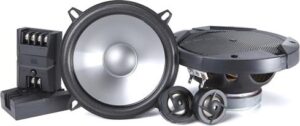
Unlike their counterparts, component speakers fire directly from knee level, making the music pierce into your ears with realism. But that’s not all. Crafted for the flow of high‑quality sound throughout your car, component speakers include individual tweeters and woofers that blend together to complete the design. Although supplied separately, the installation job may become more tedious, but you can expect years‑long enjoyment of best‑heard music with nothing to compromise—even in an already‑compact car.
The three separate components that make up a component speaker system are:
- Woofer – Handles low frequencies (bass and mid‑bass).
- Tweeter – Reproduces high frequencies (treble and harmonics).
- Crossover – Splits the audio signal, sending appropriate frequencies to each driver.
Component vs. Coaxial (Full‑Range) Speakers: Which Do You Need?
Aftermarket car speakers can be divided into two main categories: full‑range (coaxial) speakers and component speaker systems. Let’s clarify each and examine their pros and cons.

Full‑Range (Coaxial) Speakers
Full‑range speakers contain all speaker parts in a single basket. In their simplest form, they include a woofer for lows and a tweeter mounted onto the woofer to produce highs. Some models may have additional drivers like a midrange or supertweeter. Choose full‑range speakers if you’re looking to replace factory speakers with minimal fuss. They come in a variety of sizes that mount easily into factory speaker locations. Typically, you remove the old speaker, connect the new one with a free wiring harness, and mount it. You’ll find full‑range speakers at nearly every price point and power range.
Component Speakers
Component systems use a superior speaker design to deliver the best possible sound. A typical component system contains separate woofers, tweeters, and external crossovers—all designed to work in concert with one another. This separation allows for optimal placement of each driver, resulting in better sound staging, imaging, and overall clarity.
| Feature | Coaxial Speakers | Component Speakers |
|---|---|---|
| Installation Complexity | Easy – direct replacement | Moderate to advanced – requires custom placement |
| Sound Quality | Good for basic listening | Excellent – superior staging and imaging |
| Placement Flexibility | Fixed tweeter position | Separate tweeter placement for optimal sound |
| Crossover Quality | Basic internal capacitor | External, high‑quality crossover network |
| Price Range | Low to moderate | Moderate to high |
Benefits of Component Speakers
- Superior Sound Staging: With the tweeter separated from the woofer, you can place the tweeter at ear level (e.g., A‑pillar or dash) while the woofer remains in the door. This creates a wide, realistic soundstage where instruments and vocals appear to come from the dashboard, not your feet.
- Better Imaging: Proper placement allows the sound to blend seamlessly, giving a sense of depth and directionality to the music.
- High‑Quality Crossovers: External crossovers use higher‑grade components (inductors, capacitors) to sharply separate frequencies, reducing distortion and power waste.
- Flexibility for Custom Installations: You can mount components in kick panels, door pods, or custom enclosures to match your vehicle’s interior while preserving trunk space.
- Bi‑Amping Capability: Many component crossovers allow bi‑amping—using separate amplifier channels for the woofer and tweeter—giving you even more control over the sound.
Installation Guide for Component Speakers
Installing component speakers is not an easy task, but the comfort it provides is worth the time invested. Follow these guidelines for each component.
Woofer Placement
The woofer is the best match for door panels, kick panels, or dashboards. Factory speaker locations often require little adjustment—just drill a few holes for secure fitting. If your door doesn’t have pre‑defined speaker locations, have a cutout made precisely to the woofer’s dimensions, being careful not to cut too large. Use a speaker adapter ring if needed.
Tweeter Placement
Tweeter placement is trickier. Many vehicles have factory tweeter mounts; if yours doesn’t, you need to find the ideal spot. The best location is within 12 inches of the woofer, ideally at ear level (A‑pillar, dash corners, or sail panels). Surface‑mount cups or flush‑mount adapters are often included. Avoid placing tweeters too low (like in the door panel) because high frequencies are directional and may sound muffled.
When cutting a hole for the tweeter, be leery: you can open a narrow gap but can’t quickly fill a widened one. Always measure twice before cutting.
Crossover Installation
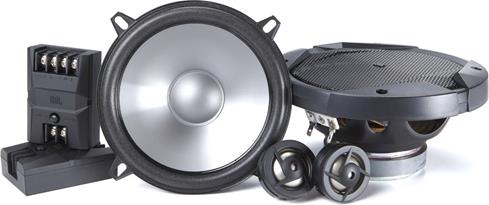
The crossover filters frequencies before they reach the drivers, reducing distortion and improving overall sound quality. Unlike the other components, the crossover does not need to be near the woofer or tweeter. It can sit anywhere in the car as long as it is secure, away from moving parts, moisture, and vibration. Ideal spots include inside the door panel, behind the kick panel, or under the dashboard. Wrap the crossover in a plastic bag with tape over openings to protect it from moisture if mounting on door metal.
Speaker Materials and Construction
A speaker’s materials determine its durability and sound quality.
Woofer Materials
To effectively produce low notes, the woofer cone should be stiff yet lightweight. Most manufacturers use:
- Polypropylene: Common, durable, and performs well.
- Mica‑reinforced polypropylene: Stiffer for more accurate bass.
- Woven materials (carbon fiber, Kevlar): Lightweight, strong, excellent response.
- Metal‑coated synthetics: Added stiffness for high‑power handling.
Tweeter Materials
Tweeter material greatly influences sound character:
- Soft dome (silk, textile blends): Produces smooth, refined highs—great for long listening sessions.
- Hard dome (metal, ceramic, graphite): Delivers bright, crisp highs with excellent detail; ideal for rock, electronic, or if you prefer energetic treble.
Surround Materials
The surround allows the woofer cone to move freely. Rubber surrounds offer the best longevity and performance in harsh automotive environments. Foam and cloth surrounds are less expensive but may degrade faster.
External Crossovers
Component systems use passive external crossovers to achieve clean frequency separation. Higher‑end crossovers often feature:
- Bi‑amp terminals: Allow separate amplification for woofer and tweeter.
- Adjustable tweeter levels: Let you fine‑tune treble output (±3 dB).
- High‑quality components: Air‑core inductors and polypropylene capacitors for minimal distortion.
Advanced Tips for Maximizing Component Speaker Performance
1. Use Sound Deadening
Doors are prone to vibration and external noise. Applying sound deadening material (like Dynamat) to the inner and outer door skins reduces rattles, improves mid‑bass response, and lowers road noise.
2. Consider Active Crossovers
For ultimate control, use a digital signal processor (DSP) or an amplifier with built‑in active crossovers. Active systems allow you to set crossover points, slopes, and time alignment digitally, yielding perfect speaker integration.
3. Bi‑Amping
If your component crossovers support bi‑amping, run separate amplifier channels to the woofer and tweeter. This gives you independent power and control over each driver.
4. Aim Tweeters for Best Imaging
Point tweeters toward the listening position (on‑axis) for maximum detail and sparkle, or slightly off‑axis for a smoother, less fatiguing sound. Experiment with angles before final mounting.
Choosing the Right Component Speakers
When shopping for component speakers, consider:
- Power handling: Match RMS power rating with your amplifier’s output.
- Impedance: Most car speakers are 4‑ohm; verify compatibility.
- Size and fit: Confirm the woofer fits your door’s mounting depth and diameter.
- Tweeter options: Look for flexible mounting (surface, flush, angled) for easier installation.
- Brand reputation: Stick with reputable brands like JL Audio, Focal, Hertz, Morel, or Alpine for consistent quality.
Maintenance and Troubleshooting
- Check connections periodically: Vibration can loosen screws and terminals.
- Keep speakers dry: Avoid moisture intrusion—use waterproof baffles if necessary.
- If you hear distortion or crackling: Check for blown drivers, loose wires, or incorrect crossover settings.
- For no sound: Verify amplifier power, signal inputs, and that the crossover is connected properly.
Summary
Component speakers offer the pinnacle of car audio sound quality by separating the woofer, tweeter, and crossover into dedicated units. While installation requires more time and planning than coaxial speakers, the reward is immersive, accurate sound with superior staging and imaging—even in space‑constrained vehicles. By following this guide, you’ll understand what component speakers are, how to choose them, and how to install them for years of listening enjoyment.


Sound quality is very amazing and great features.
thanks for nice comments keep reading and sharing
[…] built-in subwoofer in bookshelf speaker programs takes charge of the lows. It permits the principle speakers to deal with mids and highs completely, thus making a naturally optimized […]
[…] cut up off from the higher range frequency indicators throughout the crossover and directed to the complete range speaker cone. Since hey cut up the sound two methods, they have been dubbed 2-way […]
[…] exact room-filling sound in case your soundbar is top-quality. There are various kinds of soundbar speakers from completely different producers and their output […]
[…] Please note: if a quality set of component speakers is what you’re after, be sure to check out our component speaker buying guide here. […]