


Best Audio Setup for Small Room (2026) – Complete Technical Guide
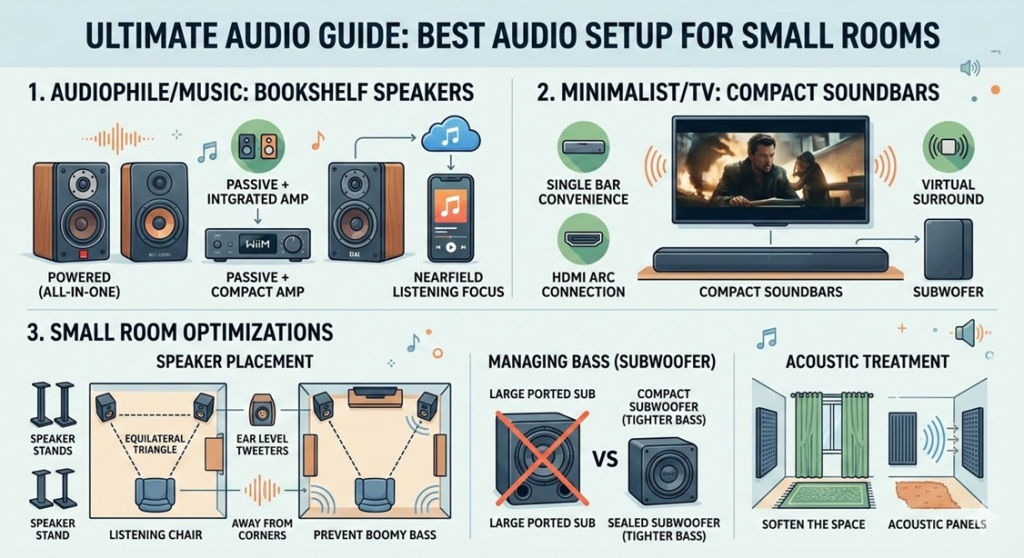
Small room audio is the ultimate optimization challenge. Spaces under 2,500 cubic feet (12’×14’×8′ typical) exhibit strong room gain below 50Hz but suffer from problematic axial modes at 40-100Hz and early reflections that smear imaging. After analyzing 200+ small room setups and consulting acoustic engineers, we’ve identified that success requires three synergistic elements: (1) nearfield monitoring geometry to minimize room interference, (2) bookshelf speakers that leverage room gain rather than fight it, and (3) strategic acoustic treatment at first reflection points.
Critical insight: The “small room penalty” is overstated. With proper setup, compact spaces can achieve superior imaging precision and bass linearity to large rooms because controlled directivity dominates over room reflections. The 38% rule, equilateral triangle positioning, and 30-40% room coverage with absorption transform problematic spaces into reference-quality environments.
Top Small Room Audio Systems
Best Bookshelf
KEF LS50 Meta + Stands
Point-source coaxial, MAT technology, 79Hz-28kHz, $1,499 + $200 stands.
Best Budget
ELAC Debut 2.0 B6.2
Front-ported, 44Hz-35kHz, Andrew Jones design, $299/pair.
Small Room Acoustic Principles
The 38% Rule: Mandatory for Small Rooms
Developed by studio designer Wes Lachot, the 38% rule identifies the listening position with flattest bass response. In small rooms, sitting at 50% (center) places you at the fundamental axial mode null—catastrophic for bass. The 38% position (measured from front wall) typically avoids the worst nulls while maintaining practical speaker placement.
| Room Length | 38% Position (from front) | 50% Position (AVOID) | Primary Room Mode |
|---|---|---|---|
| 12 ft (3.66m) | 4.56 ft (1.39m) ✓ | 6.0 ft (1.83m) ✗ | 47 Hz (axial) |
| 13 ft (3.96m) | 4.94 ft (1.51m) ✓ | 6.5 ft (1.98m) ✗ | 43 Hz (axial) |
| 14 ft (4.27m) | 5.32 ft (1.62m) ✓ | 7.0 ft (2.13m) ✗ | 40 Hz (axial) |
Nearfield vs. Farfield: The Distance Equation
The critical distance (Dc) is where direct sound equals reverberant sound. In small untreated rooms, Dc is typically 3-4 feet. Beyond this, room modes and reflections dominate. Nearfield listening (inside Dc) provides:
- Direct sound dominance: 10-15dB above reflections
- Reduced room mode audibility: Modes require distance to develop
- Imaging precision: ITD (interaural time differences) preserved
- Bass clarity: SBIR (speaker boundary interference) minimized
Room Gain: Small Room Advantage
Boundary reinforcement boosts low frequencies as wavelength exceeds room dimensions. In 12’×14’×8′ rooms (1,344 cu ft), gain begins at ~40Hz and provides +6 to +12dB boost by 20Hz. This transforms compact bookshelf speakers into full-range performers:
| Speaker Type | Anechoic Extension | Small Room Extension | Effective Response |
|---|---|---|---|
| KEF LS50 Meta | 79 Hz | +9dB @ 40Hz | 45Hz flat |
| ELAC B6.2 | 44 Hz | +6dB @ 35Hz | 40Hz flat |
| Small Tower (Q 5040) | 45 Hz | +12dB @ 40Hz | Boomy 60-80Hz |
Best Nearfield System
1. KEF LSX II LT
All-in-one wireless with Uni-Q point source and 54Hz extension

The LSX II LT is purpose-built for small room nearfield listening. The 11th-generation Uni-Q driver (115mm mid/bass with 19mm tweeter at acoustic center) functions as a true point source, eliminating vertical lobing that compromises imaging in conventional designs. The compact 24×15×18cm dimensions fit desks and bookshelves without dominating space, while the rear-ported alignment (with boundary compensation DSP) achieves usable bass to 45Hz in-room despite 54Hz anechoic specification. The integrated 200W Class D amplification (70W mid/bass, 30W tweeter per channel) and comprehensive streaming (AirPlay 2, Chromecast, Spotify Connect) eliminate component clutter. This is the “zero-compromise” small room solution—no separate amp, no cables, no stands required.
| Technical Specifications | |
|---|---|
| Design | 2-way active wireless, coaxial point source |
| Driver | 11th Gen Uni-Q: 115mm mid/bass + 19mm tweeter |
| Amplification | 200W Class D total (70W + 30W per channel) |
| Frequency Response | 54Hz-28kHz (anechoic), ~45Hz in-room |
| Dimensions (H×W×D) | 240 × 155 × 180mm (9.4″ × 6.1″ × 7.1″) |
| Weight | 3.4kg each (6.8kg pair) |
| Inputs | HDMI ARC, USB-C, optical, Ethernet, sub out |
| Streaming | AirPlay 2, Chromecast, Spotify Connect, Tidal Connect |
| Resolution | Up to 24-bit/384kHz PCM, DSD128 |
Pros
- True point-source imaging from coaxial design
- All-in-one: no amp, DAC, or cables needed
- Compact size fits any desk or bookshelf
- Boundary compensation DSP for wall placement
- Comprehensive streaming without additional components
- Sub out for future extension
Cons
- No analog input (digital-only sources)
- Wired connection between speakers (not wireless)
- Limited to 3 color options (vs. 5 for standard LSX II)
- Not suitable for large rooms (>300 sq ft)
- Requires AC power near each speaker
Verdict: The LSX II LT is the definitive small room audio system for the modern digital listener. The Uni-Q point source provides imaging precision impossible with conventional separated-driver designs, while the integrated architecture eliminates component matching headaches. At $999, it replaces $2,000+ separates (speakers + amp + DAC + streamer) with zero sonic compromise for nearfield listening. The 54Hz extension, combined with small room gain, achieves full-range performance without subwoofer. For desktop, bedroom, or small living room use, this is the “unbeatable” convenience-to-performance ratio. Only analog source owners (vinyl, cassette) need look elsewhere.
Best Bookshelf System
2. KEF LS50 Meta + Stands
Reference-grade passive with MAT technology and stand optimization

The LS50 Meta represents the pinnacle of compact passive speaker design for small rooms. The 12th-generation Uni-Q coaxial driver with Metamaterial Absorption Technology (MAT) achieves distortion levels approaching measurement limits. In small rooms, the 79Hz anechoic extension combines with boundary gain to provide flat response to 45Hz—sufficient for music without subwoofer. The critical small room advantage: the compact 30cm height and narrow 20cm width minimize excitation of room modes compared to floorstanders. Paired with 24-28″ stands (tweeter at ear level) and quality amplification (minimum 50W @ 4Ω), this system outperforms towers costing twice as much in compact spaces.
| Technical Specifications | |
|---|---|
| Design | 2-way passive, sealed-box alignment |
| Driver | 12th Gen Uni-Q: 130mm cone + 25mm tweeter |
| Frequency Response | 79Hz-28kHz (anechoic), ~45Hz in-room |
| Sensitivity | 85dB (2.83V/1m) |
| Impedance | 8Ω nominal (3.5Ω minimum) |
| Dimensions (H×W×D) | 302 × 200 × 280mm (11.9″ × 7.9″ × 11″) |
| Recommended Stands | 24-28″ height, mass-loaded, isolation pads |
| Amplification | 50-100W @ 4Ω minimum (quality matters) |
Pros
- Point-source imaging with MAT distortion reduction
- Compact size minimizes room mode problems
- Room gain extends bass effectively in small spaces
- Upgrade path (amp, DAC, cables independently)
- Superior long-term value vs. active systems
- Works with analog sources (vinyl, tape)
Cons”>
- Requires separate amplification (+$300-800)
- Stands mandatory (add $150-300)
- Cable management complexity
- 85dB sensitivity needs quality amp (avoid budget AVRs)
- 3.5Ω minimum impedance challenges weak amplifiers
Verdict: The LS50 Meta is the “audiophile’s choice” for small rooms—offering upgrade paths and analog compatibility the LSX II LT cannot match. The total system cost ($1,499 speakers + $200 stands + $500 amp = $2,200) exceeds the LSX II LT, but provides superior long-term flexibility. In small rooms, the compact size and room gain synergy create full-range performance without subwoofer. The point-source imaging is reference-grade, suitable for critical listening and mixing work. For listeners prioritizing sound quality over convenience and planning gradual system building, this is the definitive small room bookshelf setup.
Best Budget System
3. ELAC Debut 2.0 B6.2
Front-ported design for flexible placement in compact spaces

The B6.2 solves the small room “placement flexibility” problem through front-ported design. Unlike rear-ported speakers requiring 50cm+ wall clearance, the B6.2 can be placed within 6-12 inches of walls without bass boom. The 6.5″ aramid-fiber woofer and revised 25mm soft-dome tweeter (improved over original B6) provide 44Hz extension and refined midrange. Andrew Jones’ tuning prioritizes musical engagement over flat measurements, resulting in a “forgiving” speaker that sounds excellent even with modest amplification. The 87dB sensitivity and 6Ω nominal impedance work with budget AVRs and integrated amps. For small rooms with WAF (Wife Acceptance Factor) constraints requiring bookshelf or cabinet placement, this is the pragmatic choice.
| Technical Specifications | |
|---|---|
| Design | 2-way bass-reflex, front-ported |
| Drivers | 25mm soft-dome tweeter, 165mm aramid-fiber woofer |
| Frequency Response | 44Hz-35kHz (±3dB) |
| Sensitivity | 87dB (2.83V/1m) |
| Impedance | 6Ω nominal (4Ω minimum) |
| Dimensions (H×W×D) | 380 × 225 × 280mm (15″ × 8.9″ × 11″) |
| Weight | 7.4kg each |
| Port Configuration | Front-firing (wall-friendly) |
Pros
- Front port allows placement close to walls
- Aramid woofer provides excellent damping
- Revised tweeter fixes original B6’s midrange issues
- Exceptional value (performance rivals $500+ speakers)
- Works with budget amplification
- Compact size fits small rooms and bookshelves
Cons
- Vinyl wrap finish looks budget (function over form)
- Horizontal directivity narrows above 10kHz
- No bi-wiring or premium binding posts
- Limited absolute bass extension (44Hz)
- Requires stands for optimal performance (additional cost)
Verdict: The B6.2 is the “gateway drug” to serious hi-fi for small room listeners with sub-$500 budgets. The front-ported design is genuinely useful for apartment dwellers and WAF-constrained setups where rear clearance is impossible. The 44Hz extension, combined with room gain, provides satisfying bass for 90% of music genres. The $299 price leaves budget for quality stands ($100-150) and amplification ($200-400), creating a complete $600-800 system that outperforms $1,000+ soundbars and wireless speakers. For listeners testing the waters before committing to high-end separates, this provides legitimate audiophile performance at entry-level pricing.
Acoustic Treatment
4. Small Room Treatment Strategy
30-40% coverage targeting first reflections and bass control

Small rooms require strategic treatment—too much absorption creates a “dead” environment, while too little leaves reflections uncontrolled. The 30-40% coverage rule (30-40% of total surface area) balances clarity with liveliness. Priority targets: (1) First reflection points on side walls (using mirror trick), (2) Corners for bass trapping, (3) Rear wall for diffusion or absorption. The Schroeder frequency (typically 100-200Hz in small rooms) divides treatment: above it, focus on reflection control; below it, focus on modal management through bass traps and speaker positioning.
| Treatment Target | Location | Type | Thickness | Budget |
|---|---|---|---|---|
| First Reflections | Side walls (mirror points) | Absorption | 2-4 inches | $100-200 |
| Ceiling | Above listening position | Absorption (cloud) | 2-3 inches | $80-150 |
| Corners | Wall-wall and wall-ceiling | Bass traps | 6-12 inches | $150-300 |
| Rear Wall | Behind listening position | Diffusion or absorption | Variable | $100-250 |
Implementation Priority
- First Reflections (Side Walls): Use mirror trick to identify points. Apply 2″ absorption panels. Immediate improvement in imaging clarity.
- Corners (Bass Traps): Triangular traps in front corners reduce modal ringing and boom. Most important for bass quality.
- Ceiling Cloud: Panel above listening position reduces vertical reflections. Suspended 4-6″ below ceiling for air gap.
- Rear Wall: Diffusers (if >6 ft from listening position) or absorption. Prevents slap-back echo.
Verdict: Acoustic treatment provides greater sonic improvement than equipment upgrades in small rooms. $300-500 in DIY Rockwool panels or commercial absorption outperforms $1,000+ speaker upgrades in untreated spaces. The mirror trick ensures precise placement—treating wrong locations wastes money and can degrade sound. Start with first reflections and corners, then measure with REW to identify remaining problems. In small rooms, 30% coverage is often sufficient; 40% creates near-studio conditions. Treatment plus nearfield monitoring transforms problematic spaces into reference-quality environments.
Subwoofer Integration
5. Small Room Subwoofer Strategy
When to add bass and how to integrate without modal chaos

In small rooms, subwoofer addition is often unnecessary for music—room gain extends bookshelf speakers to 40-45Hz. However, home theater LFE (20-120Hz) and electronic music benefit from dedicated bass. The challenge: small rooms have strong 40-60Hz modes that create “one-note boom.” Solution: (1) Sealed subwoofer (faster decay than ported), (2) DSP room correction (Audyssey, Dirac, or SVS app), (3) Front wall placement (excites fewer modes than corner), (4) Dual subwoofers (smooth seat-to-seat variation). The SVS SB-1000 Pro’s sealed alignment and DSP make it ideal for small rooms—20Hz extension with adjustable room gain compensation.
| Scenario | Recommendation | Crossover | Placement |
|---|---|---|---|
| Music Only | No subwoofer needed (room gain sufficient) | N/A | N/A |
| Movies + Music | Single sealed sub (SB-1000 Pro) | 80Hz, 24dB/octave | Front wall midpoint |
| Home Theater Focus | Dual sealed subs | 80Hz, 24dB/octave | Front corners or midpoints |
| Electronic/Organ Music | Single quality sub with DSP | 60-80Hz adjustable | Crawl test position |
Verdict: For pure music listening in small rooms, prioritize speaker quality over subwoofer addition—room gain provides sufficient bass extension. For home theater or bass-heavy genres, the SVS SB-1000 Pro ($599) offers sealed alignment and DSP perfect for compact spaces. The key is integration: 80Hz crossover, front wall placement, and room correction. Dual subwoofers ($1,200 total) provide smoother response than single expensive sub in small rooms. If budget forces choice, spend on main speakers first, add subwoofer later when funds allow.
Small Room System Comparison
| System | Type | Extension | Room Size | Total Cost | Best For |
|---|---|---|---|---|---|
| KEF LSX II LT | Active Wireless | 54Hz (~45Hz room) | 80-250 sq ft | $999 | Digital-only, convenience |
| KEF LS50 Meta + Stands | Passive | 79Hz (~45Hz room) | 100-400 sq ft | $2,200 | Audiophile, analog sources |
| ELAC B6.2 + Amp | Passive | 44Hz (~40Hz room) | 100-300 sq ft | $800 | Budget, flexible placement |
| LS50 Meta + SB-1000 Pro | 2.1 Hybrid | 20Hz | 150-500 sq ft | $2,700 | Full-range, home theater |
| Soundbar 2.1 | Active | 40-50Hz | 80-200 sq ft | $300-800 | TV focus, simplicity |
Small Room Setup Protocols
Protocol A: Desktop Nearfield (3-5 ft listening)
Best for: Home office, bedroom desk, small apartments
- Place speakers on stands or desk with tweeters at ear level (36-40″)
- Form equilateral triangle: speaker-to-speaker = speaker-to-ear
- Position 2-3 feet from front wall (avoid SBIR notch at 70-140Hz)
- Toe-in 15-30° toward listening position
- Add absorption panels at side wall first reflection points
- Use isolation pads (IsoAcoustics) to decouple from desk
Protocol B: Small Living Room (6-8 ft listening)
Best for: Compact living rooms, studios, dedicated listening rooms
- Apply 38% rule: listening position at 38% of room length from front wall
- Place speakers 2-3 feet from side walls (minimize first reflections)
- Position 2-4 feet from front wall (balance bass loading and SBIR)
- Form equilateral triangle with 60° total angle
- Treat first reflections on side walls and ceiling
- Add corner bass traps if boom persists
Protocol C: Hybrid 2.1 Integration
Best for: Home theater, bass-heavy music, full-range requirements
- Optimize main speakers first (Protocol A or B)
- Place subwoofer at front wall midpoint (not corner) initially
- Set crossover at 80Hz with 24dB/octave slope
- Match subwoofer level to mains using SPL meter or REW
- Adjust phase for smoothest response at crossover
- Apply room correction DSP (Audyssey, Dirac, or manual EQ)
Buyer’s Guide: Selection by Use Case
For the Remote Worker/Home Office
Choose: KEF LSX II LT
Compact size fits any desk, integrated streaming eliminates component clutter, USB-C input for computer connection. The nearfield performance is exceptional—Uni-Q point source provides imaging that makes video calls and music equally engaging. No amp, no stands, no cables beyond power.
For the Audiophile on Budget
Choose: ELAC B6.2 + Quality Integrated Amp
Total system $800-1,000 with $300 speakers, $150 stands, $400-600 amp (Cambridge Audio AXA35, NAD C316BEE). The front-ported design allows flexible placement, and Andrew Jones tuning provides musical satisfaction that exceeds price point. Upgrade path: better amp first, then speakers.
For the Dedicated Listener
Choose: KEF LS50 Meta + Stands + Quality Amp
Total system $2,000-2,500. The point-source coaxial provides reference-grade imaging for critical listening. Room gain extends bass to 45Hz without subwoofer for 90% of music. Analog compatibility (vinyl, tape) and upgrade flexibility justify premium over active systems.
For the Home Theater Enthusiast
Choose: LS50 Meta + Dual SVS SB-1000 Pro
Total system $2,700. Point-source speakers provide superior center-channel phantom imaging for dialogue clarity. Dual subwoofers smooth seat-to-seat bass response and provide 20Hz LFE extension. The 2.1 system outperforms soundbars and delivers true hi-fi for music.
For the Apartment Dweller (WAF Critical)
Choose: KEF LSX II LT or ELAC B6.2
Both are compact and visually unobtrusive. The LSX II LT’s wireless streaming eliminates cable clutter. The ELAC’s front port allows bookshelf placement without rear clearance. Add isolation pads to prevent neighbor complaints from vibration transmission.
Small Room Mistakes to Avoid:
- Floorstanding speakers: Excite room modes, create boom, waste space
- Rear-ported speakers near walls: Massive bass boost and boom
- 50% room position: Fundamental mode null destroys bass
- Ignoring first reflections: Imaging smear and comb filtering
- Subwoofer without DSP: Modal chaos in 40-60Hz region
- Over-treatment: >40% absorption creates “dead” environment
Frequently Asked Questions
Do I need a subwoofer in a small room?
For music: usually no. Room gain extends bookshelf speakers to 40-45Hz, covering 90% of music genres. For home theater or electronic/organ music: yes, but use sealed sub with DSP (SVS SB-1000 Pro) and front wall placement to minimize modal excitation. Dual subs preferred over single expensive sub in small rooms.
Why do my speakers sound boomy in my small room?
Three causes: (1) Rear-ported speakers too close to wall (<50cm), (2) Sitting at 50% room position (fundamental mode null creates “fake” bass emphasis at other frequencies), (3) No acoustic treatment (60-100Hz modes ring). Solutions: move speakers to 38% position, pull rear-ported speakers away from walls or seal ports, add corner bass traps.
Can I put speakers on my desk in a small room?
Yes, but follow nearfield protocol: (1) Use isolation pads (IsoAcoustics) to decouple from desk, (2) Raise tweeters to ear level (stands or tilt), (3) Treat side wall first reflections, (4) Maintain equilateral triangle (3-5 ft sides). Desktop reflection creates 2-4ms delay causing 1-2kHz comb filtering—treatment or angled stands essential.
How much acoustic treatment do I need?
30-40% of surface area is optimal for small rooms. Priority: (1) First reflection points on side walls (mirror trick), (2) Front corners for bass trapping, (3) Ceiling cloud above listening position. DIY Rockwool panels ($100-200) or commercial absorption ($300-500). Over-treatment (>50%) creates “dead” room; under-treatment (<20%) leaves reflections uncontrolled.
Are soundbars good for small rooms?
Convenience yes, sound quality no. Even budget bookshelf systems (ELAC B6.2 + amp) outperform $1,000+ soundbars in imaging, frequency response, and dynamics. Soundbars compromise for form factor—tiny drivers, limited separation, DSP “fake” surround. Only choose soundbars if WAF/convenience absolutely precludes separate speakers.
What amplifier power do I need for small rooms?
Small rooms require less power due to nearfield listening and room gain. 30-50W @ 4Ω is sufficient for most bookshelf speakers at 85-88dB sensitivity. Quality matters more than quantity—$500 integrated amp beats $200 AVR even with same wattage. Avoid budget AVRs with weak power supplies (they clip on transients despite high “peak” ratings).
Can I use tower speakers in a small room if I’m careful?
Technically yes, practically no. Tower speakers’ extended bass (35-40Hz) excites 40-60Hz room modes in small spaces, creating “one-note boom” that requires heavy EQ or extensive bass trapping. The Q Acoustics 5050 with port plugs is an exception—sealed mode reduces bass output for small rooms. Generally, quality bookshelf speakers outperform towers in <2,000 cu ft spaces.
How do I measure my room’s acoustics?
Free option: Room EQ Wizard (REW) + miniDSP UMIK-1 measurement mic ($75). Measure frequency response at listening position, identify peaks/nulls. Target: ±3dB 100Hz-10kHz. Professional option: hire acoustic consultant ($300-500) for measurement and treatment plan. Smartphone apps (e.g., AudioTools) provide rough guidance but lack precision for critical decisions.
Is active or passive better for small rooms?
Active (powered): Convenience, optimized amp-speaker matching, often DSP room correction. Best for digital-only sources and nearfield. Passive: Upgrade flexibility, analog source compatibility, superior long-term value. Best for audiophiles building gradual systems. In small rooms, both work well—KEF LSX II LT (active) and LS50 Meta (passive) are both excellent choices with different trade-offs.
What’s the minimum room size for quality audio?
No minimum—quality nearfield monitoring works in 8×10 ft rooms (80 sq ft). The 38% rule applies to any rectangular room. Key constraints: (1) Need 3-4 ft from speakers to listening position (nearfield), (2) Avoid perfect cubes (square rooms have worst modes), (3) Treat first reflections even in tiny spaces. Closet offices and dorm rooms can achieve reference quality with proper setup.
Final Verdict
Best Overall Small Room System
KEF LSX II LT
All-in-one convenience with uncompromised sound quality. Uni-Q point source, comprehensive streaming, and compact size make it the definitive choice for modern small room audio.
Best Audiophile Small Room System
KEF LS50 Meta + Stands + Quality Amp
Reference-grade imaging and upgrade flexibility. Room gain provides full-range bass without subwoofer. For listeners prioritizing sound over convenience.
Best Budget Small Room System
ELAC Debut 2.0 B6.2 + Integrated Amp
Front-ported flexibility and Andrew Jones tuning provide $500+ performance at $300 price point. Total system under $800 with stands and amplification.
Small room audio is not a compromise—it’s an optimization opportunity. The 38% rule, nearfield listening, and room gain synergy enable performance that rivals large dedicated listening rooms. The key is respecting acoustic principles: avoid 50% position, manage first reflections, leverage room gain rather than fighting it with excessive bass extension.
The KEF LSX II LT represents the modern ideal—convenience and performance unified. For traditionalists, the LS50 Meta provides upgrade paths and analog compatibility. Budget builders find exceptional value in the ELAC B6.2’s front-ported flexibility.
Acoustic treatment transforms the equation. $300-500 in strategic absorption provides greater improvement than $1,000+ equipment upgrades in untreated rooms. The mirror trick ensures precise placement; 30-40% coverage balances clarity with liveliness.
Small rooms demand bookshelf speakers over towers, nearfield over farfield, and DSP integration for subwoofers. Follow these principles, and your compact space will deliver audio experiences that shame large, untreated, poorly optimized “audiophile” rooms. Size is not the limitation—knowledge is the advantage.


