
The Complete Home Audio Buying Guide: Find Your Perfect Sound
Great audio transforms a house into a home. Whether you’re trying to replicate the cinema experience in your living room or you want to hear every breath in a jazz vocalist’s performance, the right system changes everything.
But the world of home audio is noisy-literally and figuratively. Between acronyms like Dolby Atmos, DACs, and Watts RMS, it’s easy to get lost.
This guide is designed to cut through the jargon and help you find the perfect setup for your ears, your room, and your budget.
1. Define Your “Listening Profile”
Before looking at a single speaker, you need to identify how you will use the system. Most buyers fall into one of three categories:
- The Cinephile: You want your floor to shake when a dinosaur steps on screen. Dialogue clarity and directional surround sound are your top priorities. Best Fit: Full Surround Sound System (5.1 or higher) or Premium Soundbar with Subwoofer & Satellite Speakers.
- The Audiophile (Music First): You care about soundstage, instrument separation, and fidelity. You want to sit in a chair and listen to an album from start to finish. Best Fit: Stereo Hi-Fi System (2.0 or 2.1 with quality components).
- The Background Listener & Entertainer: You want great-sounding music while you cook, clean, or host friends. Convenience, multi-room capability, and clean design are priorities. Best Fit: Multi-room Wireless Speaker Ecosystem (e.g., Sonos, Bluesound, Apple HomePod) or a quality soundbar for TV.
- The Hybrid User: You want excellent performance for both movie nights and weekend music listening, all in one shared living space. Best Fit: A versatile AV Receiver paired with a quality speaker set (start with 3.1 or 5.1), offering a great balance.

2. Choose Your System Type: A Detailed Comparison
Just as headphones come in various forms, home audio has distinct setups. Here’s how they compare at a glance.
| System Type | Best For | Core Components | Pros | Cons | Budget Starting Point |
|---|---|---|---|---|---|
| Soundbar (+ Sub) | Cinephiles, Background Listeners, Small Spaces | Soundbar, (often) Wireless Subwoofer | Minimal wires, easy setup, clean look, great TV upgrade | Limited soundstage, less musical, rarely upgradable | $200 |
| Stereo Hi-Fi | Audiophiles, Music-First Hybrids | 2 Speakers, Amplifier, Source (Streamer, etc.) | Best music fidelity, wide soundstage, highly upgradable | More components & wires, requires careful setup | $500 |
| Component Surround | Dedicated Cinephiles, Hybrids with Space | AV Receiver, 5+ Speakers, 1+ Subwoofers | True immersive cinema, flexible, powerful | Expensive, complex setup, many wires | $800 |
| Wireless Multi-Room | Background Listeners, Whole-Home Audio | Multiple standalone smart speakers | Whole-home sync, super convenient, app-controlled | Less powerful, can be costly to scale, proprietary | $220 per speaker |
A. Soundbars (The “All-in-One” Solution)
A soundbar is a long speaker cabinet that sits below your TV, often sold with a separate wireless subwoofer. Modern ones can simulate surround sound using psychoacoustics and side-firing drivers.
Key Insight: Look for a center channel. In a soundbar, this is often a dedicated driver or virtual processing specifically for locking dialogue to the screen and making it clear. A “3.1” soundbar (Left, Center, Right, Sub) is a major upgrade over a “2.1” for movie dialogue.
Consider: High-end models now support Dolby Atmos via up-firing speakers or virtualization. While not as authentic as ceiling speakers, it adds noticeable height and immersion.
B. Stereo / Hi-Fi Systems (The Purist’s Path)
This is the two-channel system revered for music. It requires separate components but offers unparalleled clarity and a tangible “soundstage”-the ability to close your eyes and pinpoint where each instrument is in the room.
The Core Stack:
- Source: This could be a network streamer (for Spotify/Tidal), a turntable, or a CD player.
- Amplification: An Integrated Amplifier combines a pre-amp (controls volume/input selection) and a power amp (drives the speakers) in one box. Some now include streaming (Streaming Amplifiers), simplifying setup.
- Speakers: The most critical choice. Bookshelf speakers need stands; floorstanding speakers have larger cabinets for fuller bass.
C. Component Surround Sound (The Home Theater Engine)
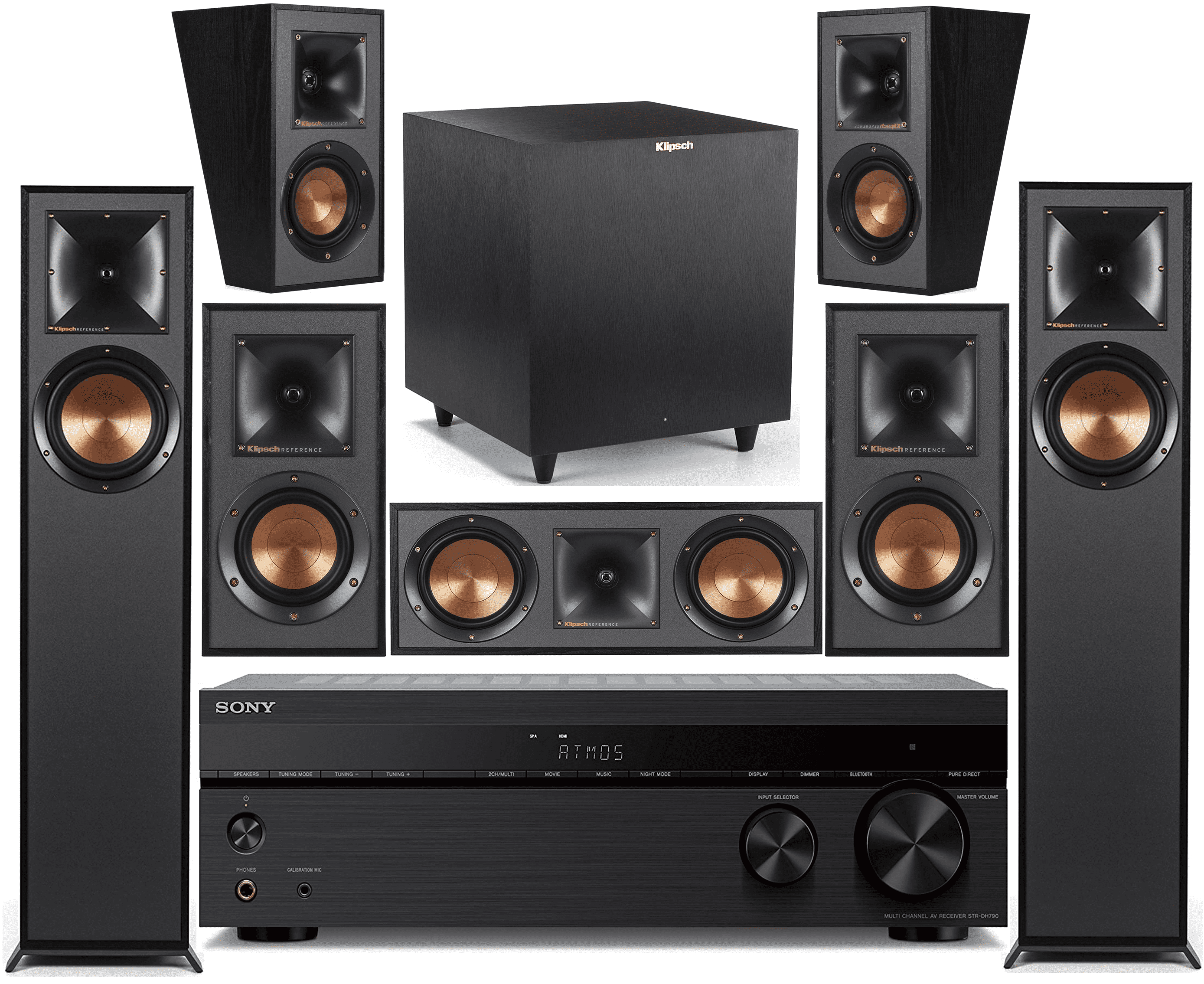
This is a modular, powerful system built around an AV Receiver (AVR). The AVR is the brain: it receives video/audio from all your devices (game console, Blu-ray player, streamer), decodes surround sound formats, amplifies the signal, and sends it to the correct speakers.
Understanding Speaker Layouts:
- 5.1.2: The standard. Five ear-level speakers, one subwoofer (.1), and two height/up-firing channels for Dolby Atmos effects.
- 7.1.4: The enthusiast standard. Adds rear surround speakers and two more height channels for a fully enveloping dome of sound.
- The .1 (LFE Channel): This is the dedicated Low-Frequency Effects channel for movie bass. It’s why a good subwoofer is non-negotiable for home theater.
3. Demystifying the Specs That Actually Matter
Power (Watts RMS)
Don’t chase wattage. A quality 50-watt-per-channel amp can sound louder and cleaner than a poor 100-watt one. Sensitivity is more telling: a speaker rated at 90dB (1W/1m) will play much louder with less power than an 85dB speaker. For a medium-sized room, 50-100 clean watts per channel is typically sufficient.
Connectivity: The HDMI Mandate
If connecting to a TV, HDMI eARC is essential. It does three things older Optical cables cannot:
- Carries the highest-quality audio formats (Dolby TrueHD, DTS-HD Master Audio, Dolby Atmos).
- Allows your TV remote to control system volume seamlessly.
- Can send audio from the TV’s apps to your sound system with one cable.
Frequency Response & The Subwoofer Question
A spec of “55Hz – 20kHz” means the speaker produces sound down to 55 Hertz (a mid-bass note). Human hearing goes down to ~20Hz (the deepest rumble). The gap between your speaker’s lowest note and 20Hz is where a subwoofer works. For full-range music and movie impact, a subwoofer is almost always recommended, even in a 2.1 music system.
4. Room Acoustics & Setup: Your Free Upgrade
Your room is the most important, and cheapest, component to optimize.
Placement Fundamentals:
- Stereo Speakers: Form an equilateral triangle with your main listening seat. The speakers and your head should all be at equal distance. Slight “toe-in” (angling them toward your ears) often sharpens the center image.
- Subwoofer: Don’t just stick it in a corner. The “subwoofer crawl” trick works: place the sub in your main listening seat, play bass-heavy content, and crawl around the room perimeter. Where it sounds best is where the sub should go.
- Surround Speakers: For 5.1, place them slightly behind and to the sides of the listening position, aimed at your ears.
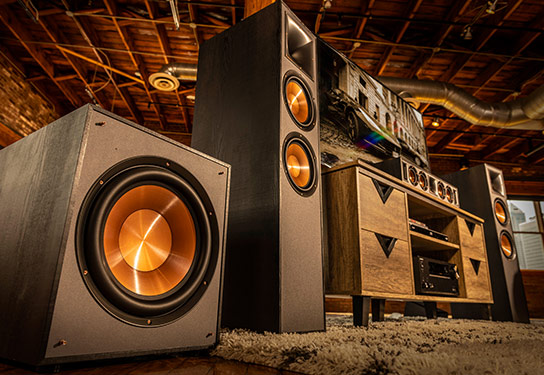
Taming Your Room: Hard, reflective surfaces (windows, bare floors, empty walls) cause sound to bounce, creating echoes and blurring detail. Absorptive materials are your friend: a thick rug on a hardwood floor, curtains over windows, and soft furniture. For a quick test, clap loudly in your room. If you hear a sharp, ringing echo (flutter), you need more soft stuff.
5. Smart Budgeting & Prioritization
The Golden Rule: Allocate your budget wisely. Speakers typically have the largest impact on sound character, so invest there first.
- Under $500: Focus on a quality 3.1 soundbar or a pair of excellent powered bookshelf speakers (like the Audioengine A5+ or Kanto YU). This gets you 80% of the way to great sound.
- $500 – $1,500: The high-value zone. You can assemble a superb 2.1 stereo system (e.g., Elac Debut speakers, SVS subwoofer, Yamaha or Cambridge Audio amp) or a very competent 5.1 home theater package from companies like Monoprice or a “home theater in a box” from SVS or Klipsch.
- $1,500 – $3,000: Performance territory. Here you get into separate components, better build quality, and more power. Consider an AV Receiver from Denon or Marantz paired with a matching speaker set from brands like Q Acoustics, KEF, or Wharfedale.
- $3,000+: Audiophile/Enthusiast land. Diminishing returns are real, but you pay for exotic materials (like beryllium tweeters), impeccable engineering, and that last 5% of performance. This is where you carefully match a high-end integrated amp (from brands like NAD, Hegel, or McIntosh) with premium speakers.
Final Checklist Before You Buy
- Profile Check: Did you honestly assess your primary use (Movies/Music/Background)?
- Room Measurement: Do you have the physical space (and WAF/Partner Approval) for the system you want?
- Wire Audit: Are you willing to run speaker wire? If not, a soundbar or wireless system is your path.
- Future-Proofing: Does your chosen AVR or amplifier have the inputs (HDMI, digital) and features (streaming, Dirac room correction) you might need in 3-5 years?
- The Listen Test: This is critical. If possible, visit a specialty audio store. Bring your own music. Listen for what you like-do you prefer a bright, detailed sound or a warm, smooth one? Your ears are the final judge.
The perfect system isn’t the most expensive one; it’s the one that disappears, leaving you only with the emotion of the music or the thrill of the movie. Take your time, trust your ears, and enjoy the journey to better sound