
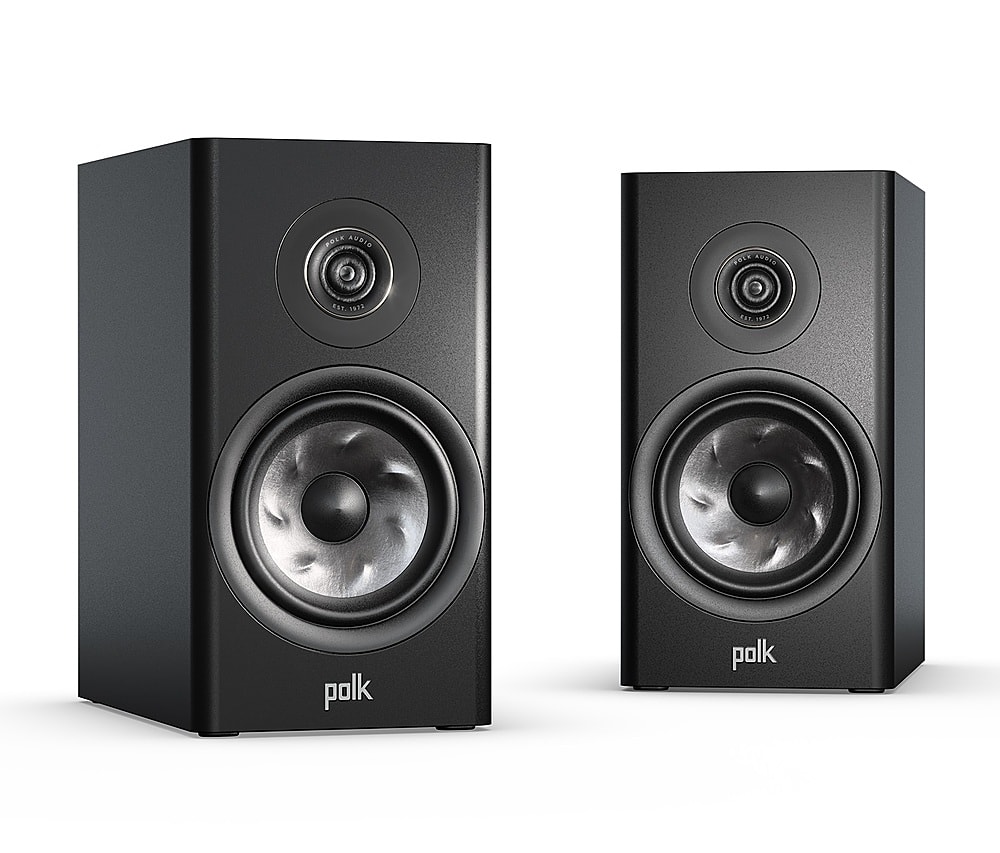

Best Polk Audio Bookshelf Speakers in 2026: Every Model Ranked & Reviewed
Top Picks at a Glance
| Category | Model | Price (Approx./pair) | Best For |
|---|---|---|---|
| Best Overall / Audiophile | Reserve R200AE | $1,299 | Hi-fi music, limited edition |
| Best Mid-Range Hi-Fi | Reserve R200 | $799 | Audiophile stereo, serious listening |
| Best Compact Hi-Fi | Reserve R100 | $499 | Small rooms, hi-res audio |
| Best for Home Theater | Signature Elite ES20 | $299 | Home theater, bass-forward listening |
| Best Under $200 | Monitor XT20 | $179 | Mid-budget stereo and surround |
| Best Budget | Monitor XT15 | $149 | First speakers, great value |
| Best Entry-Level | T15 | $99 | Beginners, surround channels |
Best Polk Audio Bookshelf Speakers 2026 — Full Reviews
🏆 Best Overall Polk Bookshelf Speaker — Polk Audio Reserve R200AE (50th Anniversary Edition)
The Polk Audio Reserve R200AE is something special — a speaker that signals what 50 years of loudspeaker engineering can produce when a company decides to pull out every stop. Limited to just 1,000 pairs worldwide, this Anniversary Edition of the already excellent Reserve R200 adds upgraded crossover components, a real cherry wood veneer finish (an upgrade over the standard R200’s walnut fiber wrap), and a level of sonic refinement that competes comfortably with speakers selling for twice the price.
At the heart of the R200AE is a 6.5-inch Turbine Cone woofer — Polk’s proprietary design that uses a foam-core polymer composite molded in a turbine geometry to dramatically increase cone stiffness without adding mass. The result is bass that extends surprisingly deep for a speaker this size, with control and integration that avoids the bloated low-end typical of budget-class ports. The X-Port technology — closed-pipe absorbers tuned to cancel internal cabinet resonances — keeps the bass clean and articulate rather than colored or boomy. Paired with Polk’s 1-inch Pinnacle Ring Radiator tweeter and carefully cross-braced cabinetry, the R200AE produces a soundstage that feels wide, natural, and genuinely three-dimensional.
In extended listening sessions with piano recordings, jazz, and orchestral music — the genres that expose every weakness in a speaker’s midrange and imaging — the R200AE holds its composure beautifully. Female vocals in particular carry a silky, natural quality that’s genuinely difficult to achieve below $2,000 per pair. This is the speaker Polk fans have been waiting for, and at $1,299 the pair, it represents exceptional value for the performance delivered. If you can still find a pair, buy them without hesitation.
| Spec | Detail |
|---|---|
| Woofer | 6.5″ Turbine Cone (foam-core polymer composite) |
| Tweeter | 1″ Pinnacle Ring Radiator |
| Frequency Response | 38Hz – 50kHz |
| Sensitivity / Impedance | 87dB / 8 Ohm nominal |
✅ Pros
- Exceptional bass control and midrange clarity for a bookshelf speaker
- Upgraded crossover parts and real cherry wood veneer over the standard R200
- Limited to 1,000 pairs — likely to hold or appreciate in value
❌ Cons
- Limited availability — difficult to find at retail price
- Still benefits from a subwoofer for deep bass below 40Hz
Buy It If… you want the finest Polk has ever made and care about long-term value as much as short-term listening pleasure.
🎵 Best Polk Bookshelf for Serious Listening — Polk Audio Reserve R200
For those who can’t track down the limited R200AE, the standard Reserve R200 is the answer — and it’s still one of the best speakers in its price range, full stop. At around $799 per pair, it carries the same 6.5-inch Turbine Cone woofer, the same Pinnacle Ring Radiator tweeter, and the same cross-braced, rounded-corner cabinet design. The primary difference over the Anniversary Edition comes down to the crossover components and the veneer finish — meaningful to a trained ear in a controlled environment, but the gap is smaller than the price difference suggests.
The R200’s soundstage is genuinely impressive. The Pinnacle tweeter’s distinctive pointed shape guides high-frequency dispersion broadly around the room — which means you’re not locked into a narrow sweet spot in front of the speakers. You can move around your room, sit at varying distances, and the image holds together with consistency that many competing bookshelf speakers at this price struggle to match. This makes the R200 particularly well-suited to rooms where the listening position isn’t fixed, or where multiple people are typically seated in different positions.
If you’re building a two-channel music system with a stereo integrated amplifier — or upgrading the front stage of a home theater — the R200 deserves serious consideration. It scales with quality amplification too. A modest $300–$400 integrated amplifier drives it well, but feed it something better and the improvement is immediately noticeable. That’s the hallmark of a genuinely capable speaker.
| Spec | Detail |
|---|---|
| Woofer | 6.5″ Turbine Cone woofer |
| Tweeter | 1″ Pinnacle Ring Radiator |
| Frequency Response | 38Hz – 50kHz |
| Amplifier Power | 20–150W recommended |
✅ Pros
- Wide, non-fatiguing soundstage with excellent imaging
- Scales well with better amplification
- Hi-Res Audio certified — supports up to 50kHz
❌ Cons
- Genuinely needs speaker stands — won’t perform well on a bookshelf
- At $799, it’s a meaningful investment that requires a matching amplifier
Buy It If… you’re building a proper two-channel stereo system and want the best Polk bookshelf available at a non-limited-edition price.
📐 Best Compact Hi-Fi Polk Speaker — Polk Audio Reserve R100
The Reserve R100 brings Polk’s flagship-derived technologies into a genuinely compact enclosure, making it the ideal choice for smaller listening spaces, desktop setups, or rooms where a full-size bookshelf speaker would overwhelm the acoustics. At $499 per pair, it inherits the same 1-inch Pinnacle Ring Radiator tweeter from the R200, partnered with a 5.25-inch Turbine Cone woofer and Polk’s Rear X-Port technology.
The X-Port system is one of the R100’s most important features and one that separates it clearly from cheaper Polk models. Rather than a traditional bass reflex port (which can produce port noise and coloration at high volumes), the X-Port uses closed-pipe absorbers tuned to the cabinet’s internal resonant frequency. This cancels unwanted resonances before they color the output — a subtle but meaningful improvement in bass quality and midrange cleanliness that becomes very obvious when you listen to it next to a conventionally ported budget speaker.
Female vocals are where the R100 truly distinguishes itself. There’s a smoothness and natural presence to voices — particularly in the upper midrange — that’s genuinely hard to achieve without spending significantly more. Hi-Res Audio certification (supporting up to 40kHz) ensures that modern lossless streaming content from Tidal, Qobuz, or Apple Music Lossless arrives without compromise. For a compact speaker at this price, the R100 is an overachiever in the most satisfying way.
| Spec | Detail |
|---|---|
| Woofer | 5.25″ Turbine Cone woofer |
| Tweeter | 1″ Pinnacle Ring Radiator |
| Frequency Response | 53Hz – 40kHz |
| Amplifier Power | 20–100W recommended |
✅ Pros
- Flagship Pinnacle Ring Radiator tweeter at a mid-range price
- Exceptional vocal clarity and smooth high-frequency reproduction
- Compact form factor — genuinely fits on a bookshelf or desk
❌ Cons
- Bass rolls off around 53Hz — a subwoofer is recommended for movies
- More expensive than the Signature Elite ES15 with less bass output
Buy It If… you have a smaller room, care deeply about vocal and high-frequency performance, and stream hi-res audio regularly.
🎬 Best Polk Bookshelf for Home Theater — Polk Audio Signature Elite ES20
If home theater is your priority — cinematic impact, wide dynamics, satisfying bass without necessarily adding a subwoofer right away — the Signature Elite ES20 is the Polk bookshelf to buy. It’s the largest model in the Signature Elite lineup, housing a 6.5-inch mica-reinforced polypropylene Dynamic Balance woofer and a 1-inch Terylene high-res dome tweeter that delivers Polk’s characteristic warm, smooth treble without a trace of harshness even at high volumes.
The ES20’s PowerPort technology is a clever engineering solution that most competing bookshelf speakers at this price don’t offer. Rather than a simple bass reflex port tube, PowerPort flares the exit of the port to smooth the transition as air leaves the cabinet and reaches the listening position. The practical result is deeper, more controlled bass without the audible port chuffing that plagues many budget-class ported speakers when pushed hard. For action movies, gaming audio, and bass-heavy music, this makes a real difference — the ES20 can go loud and low without falling apart.
At around $299 per pair, the ES20 competes in one of the most hotly contested price brackets in the speaker market. It holds its own comfortably by delivering a warm, enveloping sound signature that pairs beautifully with any of Polk’s Signature Elite center channels and tower speakers. If you’re building a full surround sound system and want consistent tonal matching across the front and surround stages, the ES20 is the natural bookshelf companion to the ES60 tower and ES35 center channel.
| Spec | Detail |
|---|---|
| Woofer | 6.5″ mica-reinforced polypropylene Dynamic Balance |
| Tweeter | 1″ Terylene high-res dome |
| Frequency Response | 44Hz – 40kHz |
| Amplifier Power | 20–150W recommended |
✅ Pros
- PowerPort technology delivers controlled, non-boomy bass extension
- Warm, smooth sound signature — excellent for long movie sessions
- Matches perfectly with Polk’s Signature Elite surround system lineup
❌ Cons
- Warm tuning sacrifices some high-frequency detail versus the Reserve series
- Large cabinet — won’t fit on a small bookshelf without overhanging
Buy It If… you’re building a home theater system and want a bookshelf speaker with real bass output, warm dynamics, and seamless tonal matching to Polk’s Elite series.
💡 Best Polk Bookshelf Under $200 — Polk Audio Monitor XT20
The Monitor XT series represents the next evolution of Polk’s classic Monitor line — a product range with decades of affordable, dependable performance behind it. The XT20 steps up from the entry-level XT15 with a larger cabinet, a 5.25-inch Dynamic Balance woofer, and an improved crossover that delivers a broader frequency response and more room-filling sound. At around $179 per pair, it’s one of the most capable speakers in this price bracket.
What’s particularly notable about the XT20 — and the whole XT series — is that it benefits directly from technology trickled down from Polk’s more expensive lines. The Terylene dome tweeter, the same material used in the Signature Elite series, delivers the smooth, extended highs that Polk is known for without the brittleness or hardness of budget metal dome alternatives. Treble is warm and forgiving on compressed streaming audio, which is where most people’s music listening actually happens in 2026.
The XT20 is a practical speaker in the best sense. It works well as the front pair in a 2.1 or 5.1 home theater system. It works equally well as a standalone stereo pair driven by an entry-level integrated amplifier or AV receiver. It’s wall-mountable when needed, fits genuine bookshelves, and its neutral appearance suits almost any décor. For the price, the performance-to-value ratio is hard to argue with.
| Spec | Detail |
|---|---|
| Woofer | 5.25″ Dynamic Balance bi-laminate woofer |
| Tweeter | 1″ Terylene dome tweeter |
| Frequency Response | 55Hz – 40kHz |
| Amplifier Power | 20–100W recommended |
✅ Pros
- Terylene dome tweeter brings upper-class smoothness to a budget price
- Versatile — works for stereo, home theater, and desktop use
- Excellent tonal balance for the price, not too bright or too bass-heavy
❌ Cons
- Bass performance benefits significantly from adding a subwoofer
- Not the last word in imaging precision for critical music listening
Buy It If… your budget is under $200 and you want a well-rounded speaker that genuinely handles both music and movies without compromise.
💰 Best Budget Polk Bookshelf Speaker — Polk Audio Monitor XT15
The Monitor XT15 is the speaker you recommend to a friend who’s just starting out and wants to spend around $150 without getting burned. It’s honest, capable audio at a price that still leaves room in the budget for a decent amplifier or AV receiver — which is exactly the right way to think about building a first system. You can always upgrade speakers later. Spending everything on the speakers and nothing on amplification is a classic first-timer mistake, and the XT15 helps you avoid it.
Under the hood, the XT15 uses Polk’s 1-inch Terylene dome tweeter — the same tweeter material found in the more expensive Signature Elite series — and a 5.25-inch bi-laminate paper cone woofer for midrange and bass. The Terylene tweeter is the key differentiator that separates the XT15 from cheap competition: it provides warm, extended highs without the harsh edge that cheap plastic or aluminum dome tweeters deliver. On vocals, acoustic guitar, and piano, the XT15 sounds smooth and inviting in a way that doesn’t cause listening fatigue over time.
Bass is present and punchy for a speaker this size, though deep low-frequency extension is inevitably limited by the cabinet volume and driver size. For music listening alone, most users won’t miss what isn’t there. For movies and gaming, pairing the XT15 with a budget subwoofer transforms the experience — a combination that still fits well under $300 total and will outperform any soundbar at a comparable price.
| Spec | Detail |
|---|---|
| Woofer | 5.25″ bi-laminate Dynamic Balance cone |
| Tweeter | 1″ Terylene dome tweeter |
| Frequency Response | 60Hz – 40kHz |
| Amplifier Power | 20–100W recommended |
✅ Pros
- Terylene tweeter delivers smooth, warm highs far beyond the price point
- Excellent value — hard to beat at $149/pair
- Works as front, surround, or rear speakers in a full home theater setup
❌ Cons
- Bass rolls off early — a subwoofer is needed for movies
- Cabinet construction reflects the price point
Buy It If… you’re starting from scratch and want a genuinely capable first pair of bookshelf speakers without overspending on the speakers at the expense of your amplifier.
🪙 Best Entry-Level Polk Bookshelf — Polk Audio T15
The Polk T15 has been a steady presence in the home audio market for years, and its continued popularity says everything about what it delivers at around $99 per pair. These are not audiophile speakers — Polk doesn’t market them as such, and it would be unfair to judge them on those terms. They’re built with a specific mission: to be the most capable speakers possible for buyers with $100 to spend, and in that mission, they succeed convincingly.
The 5.25-inch Dynamic Balance mineral-filled polymer composite woofer handles midrange and bass with more composure than the price suggests. Polk’s VP of Engineering noted publicly that the T15 was deliberately engineered for real-world placement — on furniture at slightly above or below ear level, or as surround channels positioned above the listening position. That’s an honest acknowledgment that most people don’t use bookshelf speakers on proper stands at ear height, and it informs a design that sounds good in the positions people actually use. Treble is handled by a 0.75-inch Dynamic Balance silk dome tweeter, which keeps highs smooth rather than sharp — a forgiving quality on compressed streaming audio.
For surround channel duty in a 5.1 system, the T15 is one of the best values in home audio. Mount them on the side walls, connect them to your AV receiver, and they disappear into the soundfield in exactly the way a good surround speaker should. As a front pair for casual music listening, they’re perfectly serviceable. For critical music listening or demanding home theater use as the main front speakers, they’ll show their limitations — but that’s not what they’re for.
| Spec | Detail |
|---|---|
| Woofer | 5.25″ Dynamic Balance polymer composite |
| Tweeter | 0.75″ silk/polymer dome |
| Frequency Response | 65Hz – 24kHz |
| Amplifier Power | 20–100W recommended |
✅ Pros
- Remarkable performance at the $99/pair price point
- Wall-mountable — ideal for surround channels in a 5.1 or 7.1 system
- Supports Dolby and DTS surround decoding from connected AV receivers
❌ Cons
- Midrange can sound slightly “cupped” or congested on critical listening
- High-frequency extension limited to 24kHz — not hi-res capable
Buy It If… you need a second or third pair of speakers for surround duty, or you’re building your very first home audio system on an absolute shoestring.
Full Comparison Table — Best Polk Audio Bookshelf Speakers 2026
| Model | Price/pair | Woofer | Tweeter | Freq. Response | Hi-Res Certified | Best Use |
|---|---|---|---|---|---|---|
| Reserve R200AE | $1,299 | 6.5″ Turbine Cone | 1″ Pinnacle Ring Radiator | 38Hz–50kHz | ✅ | Audiophile 2-channel |
| Reserve R200 | $799 | 6.5″ Turbine Cone | 1″ Pinnacle Ring Radiator | 38Hz–50kHz | ✅ | Serious stereo listening |
| Reserve R100 | $499 | 5.25″ Turbine Cone | 1″ Pinnacle Ring Radiator | 53Hz–40kHz | ✅ | Compact hi-fi, hi-res streaming |
| Signature Elite ES20 | $299 | 6.5″ Dynamic Balance | 1″ Terylene dome | 44Hz–40kHz | ✅ | Home theater, bass-forward |
| Monitor XT20 | $179 | 5.25″ Dynamic Balance | 1″ Terylene dome | 55Hz–40kHz | ✅ | Stereo + home theater |
| Monitor XT15 | $149 | 5.25″ bi-laminate cone | 1″ Terylene dome | 60Hz–40kHz | ✅ | First speakers, budget system |
| T15 | $99 | 5.25″ polymer composite | 0.75″ silk dome | 65Hz–24kHz | ❌ | Entry-level, surround duty |
Polk Audio Bookshelf Speaker Buyer’s Guide 2026: How to Choose the Right Model
1. Understand Polk’s Product Tiers Before You Shop
Polk organizes its lineup into clearly defined tiers, each targeting a different buyer. The T-series (T15, T50) is the entry-level range — solid performance at accessible prices. The Monitor XT series is the mid-entry tier, bringing better drivers and improved cabinet construction. The Signature Elite series is the sweet spot for home theater enthusiasts, with PowerPort bass technology and Terylene tweeters throughout. The Reserve series is Polk’s statement hi-fi line, inheriting technology directly from the flagship Legend series — Turbine Cone woofers, Pinnacle Ring Radiator tweeters, and cross-braced cabinets built for serious listening.
2. Passive Speakers Need an Amplifier — Don’t Forget This Step
Every speaker on this list is a passive speaker, which means it requires a separate amplifier or AV receiver to function. This is the most common mistake first-time buyers make: they choose the speakers, forget about the amplifier, then either buy a mismatched unit in a panic or discover they’ve underbudgeted. For stereo listening, a basic stereo integrated amplifier starting around $200–$300 will drive any Polk on this list adequately. For home theater, any mid-range AV receiver in the $300–$500 bracket will work well. If you want to skip the amplifier entirely, look at Polk’s powered speaker options — but for the models on this list, an amplifier is required.
3. Speaker Placement Matters as Much as the Speaker Itself
The single most overlooked factor in speaker performance isn’t the speaker — it’s where it ends up sitting. A Reserve R200 sitting on a TV cabinet far from the listening position will underperform a Monitor XT15 on proper stands at ear height in front of the listener. For the best results: position bookshelf speakers so the tweeter is approximately at ear level when seated. Keep them at least 1–2 feet from the rear wall to let bass develop naturally. Toe them in slightly toward the listening position. And if budget allows, invest in a pair of speaker stands — they make a more meaningful difference than most audio accessories.
4. Do You Need a Subwoofer?
Every bookshelf speaker — including the Reserve R200 — has physical limits on bass extension. The laws of physics don’t care about price. Bookshelf speakers, by virtue of their cabinet volume and driver size, typically roll off bass response somewhere between 38Hz and 65Hz. Below that, you lose film score impact, bass guitar weight, and deep electronic music texture. For home theater use, a subwoofer is essentially non-negotiable. For music listening in a small-to-medium room, many people find the bass extension from the ES20 or R200 satisfying enough on its own — but adding a subwoofer crossed over around 60–80Hz will always improve performance regardless of speaker quality.
5. Matching Polk Speakers Across a Surround System
Polk’s product lines are designed to match each other tonally within a series. Mixing a Signature Elite ES20 bookshelf with a Signature Elite ES35 center channel and ES60 tower speakers as the front left/right produces a seamlessly matched surround system with consistent timbre across all channels. Mixing between series (e.g., a Reserve center channel with Signature Elite surrounds) introduces tonal inconsistency that can become noticeable on film dialog and panning effects. Where possible, stay within the same product line for a full surround setup.
6. Polk’s Sound Signature: What to Expect
Polk has a recognizable house sound that has remained consistent across decades: warm, smooth, and forgiving. Their speakers tend to be slightly richer in the low midrange and rolled-off in the extreme high frequencies compared to some competing brands known for a brighter, more “analytical” presentation. This makes Polk speakers particularly enjoyable for long listening sessions — they don’t fatigue the ears over time the way some bright-sounding alternatives can. It also makes them forgiving of less-than-perfect source material: compressed streaming audio, older recordings, and movie soundtracks all tend to sound pleasant through Polk speakers where a brighter speaker might expose their flaws.
💡 Pro Tips: Getting the Best Sound from Your Polk Bookshelf Speakers
- Use speaker stands for the Reserve and Signature Elite series. These speakers are engineered for stand-mounting at ear height — placing them on a low shelf or TV cabinet dramatically reduces their imaging and soundstage performance. Even budget stands from $50–$80 make a meaningful difference.
- Bi-wire if your amplifier supports it. The Reserve R200 and R100 include dual binding posts for bi-wiring. While the improvement is subtle, it can sharpen transient response and slightly reduce intermodulation distortion — worth trying if you have the cabling.
- Break in your speakers before critical listening. New Polk speakers — particularly the Reserve series — benefit from 50–100 hours of break-in time as the woofer surrounds loosen and the crossover components settle. Run them at moderate volume with varied music content for the first few weeks before making final placement or EQ judgments.
- Try them with a high-quality streaming DAC. The Reserve R100 and R200 are Hi-Res Audio certified for good reason. Pairing them with a quality DAC and a lossless streaming service like Tidal HiFi or Qobuz unlocks a level of detail and transparency that compressed streaming cannot provide.
- Set your AV receiver’s crossover correctly. For any Polk bookshelf paired with a subwoofer, set the crossover point in your receiver to 80Hz (the THX standard) and set the speaker size to “Small.” This hands low bass duties to the subwoofer, which handles them more efficiently, while freeing the bookshelf woofer to focus on midrange and upper bass where it excels.
⚠️ Warnings: Common Mistakes When Buying Polk Bookshelf Speakers
- Don’t buy passive speakers without budgeting for an amplifier. Every speaker on this list needs a stereo amp or AV receiver to make sound. Budget at least $200–$300 for a basic amplifier alongside your speaker purchase — otherwise you’ll either overspend on speakers you can’t properly drive, or underspend on an amplifier that holds back good speakers.
- Don’t judge bass performance without a reference point. Polk’s warm sound signature can make it feel like the speakers have more bass than they actually measure. Listen to content you know well, with bass lines at different frequencies, before deciding whether a subwoofer is needed. Most people’s rooms benefit from one.
- Don’t mix product series in a surround system without testing. A Signature Elite front stage paired with T-series surrounds will produce a tonally inconsistent soundfield on surround content. Stay within one series for the best results across a full surround setup.
- Don’t place bookshelf speakers directly against a rear wall. Close rear-wall placement reinforces bass — which sounds good initially but quickly becomes bloated and boomy at higher volumes. Pull them out at least 12–18 inches from the rear wall, or use the port-blocking foam plugs included with some Polk models to tighten bass response in constrained placements.
- Don’t assume a higher price means a better speaker for every use. The Reserve R200 is technically superior to the Signature Elite ES20 in imaging and detail. But for a large living room home theater system at high volumes, the ES20’s warmer tuning, PowerPort bass technology, and higher sensitivity often make it the more satisfying practical choice. Match the speaker to the application, not just the price.
What the Audiophile Community Says About Polk in 2026
Polk Audio occupies an interesting position in audiophile conversations. Among hardcore enthusiasts, the brand is sometimes dismissed as “mass-market” — a label that’s increasingly unfair given what the Reserve series delivers at its price points. The R200AE, in particular, has earned genuine respect from the community, drawing comparisons to speakers from European boutique brands charging two to three times the price.
On the Polk Audio Forum and broader audiophile communities, a clear pattern emerges: longtime Polk fans often point to the older LSi and RTi series as sonic references — speakers from a golden era of Polk engineering that fetched premium prices and delivered accordingly. The current Reserve series is frequently described as the spiritual successor to those designs, updated with modern materials and manufacturing without abandoning the fundamentals that made the originals special.
The consensus on the budget end is equally strong: the Monitor XT15 and T15 consistently appear in “best first speakers” recommendation threads across Reddit’s r/audiophile, AVS Forum, and AudioScienceReview. Their combination of smooth tonal balance, acceptable sensitivity, and honest pricing makes them the easy recommendation for anyone starting from zero. Polk has never made bad speakers — they’ve always made honest ones — and that reputation holds in 2026.
Frequently Asked Questions — Polk Audio Bookshelf Speakers
Are Polk Audio bookshelf speakers good for music?
Yes — particularly the Reserve series. The R100 and R200 deliver a warm, detailed, non-fatiguing sound signature that suits music listening well. Their Hi-Res Audio certification and wide frequency response make them excellent companions for lossless streaming. Even the budget Monitor XT15 handles music admirably for its price.
What amplifier do I need for Polk bookshelf speakers?
Most Polk bookshelf speakers have 8-ohm nominal impedance and sensitivity between 85–88dB, making them easy to drive with modest amplification. For stereo listening, a 50–100W per channel integrated amplifier works excellently. For home theater, any mainstream AV receiver in the $300–$600 range drives them well. The Reserve series scales noticeably with better amplification — a $500+ integrated amplifier reveals detail that budget receivers mask.
Do Polk bookshelf speakers need a subwoofer?
For music in smaller rooms, the ES20 and R200 can manage without one. For home theater, a subwoofer is highly recommended — even the best bookshelf speakers physically cannot reproduce the sub-40Hz bass that defines cinematic impact. Polk’s own PSW series subwoofers are well-matched to their bookshelf lineup tonally.
What is the Polk Audio Turbine Cone and why does it matter?
The Turbine Cone is Polk’s proprietary woofer design used in the Reserve series. It combines a foam-core polymer composite with a turbine-geometry molding that dramatically increases cone stiffness without adding mass. This lets the woofer move faster and more accurately, reducing distortion and improving bass extension and midrange clarity. It’s one of the key reasons the Reserve series sounds significantly better than lower-tier Polk models.
Which Polk bookshelf speaker is best for vinyl?
The Reserve R100 or R200 are the ideal matches for vinyl playback. Their warm, smooth tonal character complements the analog warmth of vinyl beautifully, while the Pinnacle Ring Radiator tweeter retrieves the harmonic detail that makes vinyl special without tipping into brightness. Pair them with a phono-equipped integrated amplifier or a separate phono stage for best results.
Are Polk Audio speakers worth the money in 2026?
Yes, across essentially every price tier. The T15 and Monitor XT15 punch well above their price brackets. The Signature Elite ES20 offers competitive performance at $299/pair that rivals more expensive competition. The Reserve R200 and R200AE are genuinely excellent speakers by any standard — not just “good for the money.” Polk has always offered honest value, and the current lineup continues that tradition.
Final Verdict: The Best Polk Bookshelf Speaker Depends on How You Listen
Polk Audio’s bookshelf speaker lineup in 2026 is one of the most coherent and value-dense ranges in home audio. Whether you’re spending $99 on your first pair of speakers or $1,299 on a limited-edition audiophile statement, there’s a Polk designed specifically for your situation — and it will almost certainly outperform similarly-priced competition from brands without Polk’s five decades of loudspeaker engineering behind them.
The Reserve R200AE is the pinnacle — track one down if you can. The Reserve R200 is the practical alternative for serious listeners. The Signature Elite ES20 is the sweet spot for home theater enthusiasts who want real bass and a warm, cinematic sound without overspending. And the Monitor XT15 remains one of the best “first speaker” recommendations in the market. Whatever your budget or use case, Polk has you covered.


