
Best Soundbars for TV in 2026: Expert-Tested Picks for Every Budget
Top Picks at a Glance
| Category | Model | Price (Approx.) | Best For |
|---|---|---|---|
| Best Overall | Sonos Arc Ultra | $999 | Premium all-in-one Atmos |
| Best Premium System | Samsung HW-Q990F | $1,499 | Full surround, 11.1.4 channels |
| Best Mid-Range | Samsung HW-Q800F | $699 | 5.1.2 Dolby Atmos, mid-budget |
| Best Under $600 | Klipsch Flexus Core 200 | $549 | Real up-firing Atmos drivers |
| Best Compact | Sonos Beam Gen 2 | $499 | Small rooms, expandable |
| Best Budget System | Hisense AX5125H | $249 | Budget surround with sub |
| Best Under $200 | Polk Audio Signa S4 | $199 | Entry-level with subwoofer |
| Best Hi-Fi | Klipsch Flexus Core 300 | $1,199 | Audiophile-grade with Dirac Live |
Best Soundbars for TV 2026 — Full Reviews
🏆 Best Overall Soundbar 2026 — Sonos Arc Ultra
The Sonos Arc Ultra is the benchmark by which every other premium soundbar is judged right now. Released as a significant upgrade over the original Arc, it delivers a more convincing Dolby Atmos experience with noticeably better height placement, tighter low-end, and crisper dialogue — all from a single, elegantly slim unit that looks like it belongs under any high-end TV.
In real-world testing with action-heavy films and streaming content, the Arc Ultra consistently keeps dialogue locked to the screen even when explosions, music, and environmental effects compete for space in the mix. Height cues — those overhead effects that define true Atmos immersion — feel genuinely three-dimensional rather than just “slightly elevated.” That’s where many competing soundbars fall short, and where the Arc Ultra consistently delivers.
One of its strongest selling points is expandability. The Arc Ultra works brilliantly on its own, but it’s also the foundation of Sonos’ entire ecosystem. Add a Sonos Sub for earth-shaking low end, pair it with two Era 300 speakers for true wireless surround, and you have one of the most immersive home theater setups money can buy — no cables, no AV receiver, no complexity. Setup takes minutes. The Sonos app handles the rest.
| Spec | Detail |
|---|---|
| Channels | 9.0 (internal drivers) |
| Audio Formats | Dolby Atmos, Dolby TrueHD, PCM |
| Connectivity | HDMI eARC, Wi-Fi, AirPlay 2, Bluetooth |
| Smart Assistants | Amazon Alexa (built-in), Google Assistant, Apple Siri |
✅ Pros
- Exceptional Dolby Atmos height immersion
- Expandable into a full wireless surround system
- Gorgeous design, premium build quality
❌ Cons
- No DTS:X support
- Premium price — expansion adds significant cost
Buy It If… you want the best-sounding single-bar Dolby Atmos soundbar available and plan to eventually build it into a full wireless home theater system.
💎 Best Premium Soundbar System — Samsung HW-Q990F
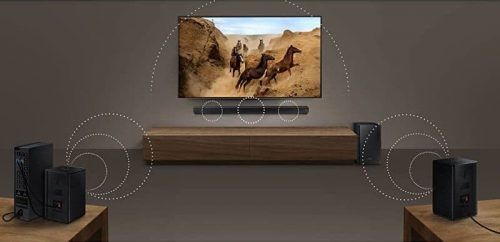
If you want a complete, out-of-the-box home theater audio system and price isn’t the primary concern, the Samsung HW-Q990F is the package to beat. It’s Samsung’s flagship for 2026 — an evolved version of the well-regarded Q990D — featuring an 11.1.4 channel configuration that includes the soundbar itself, two wireless surround speakers, and a redesigned wireless subwoofer. It’s the closest a soundbar system has come to replicating the envelopment of a true dedicated speaker setup.
Samsung’s Q-Symphony technology is a genuinely clever differentiator here. If you own a compatible Samsung TV, the television’s own speakers blend with the soundbar’s output rather than going silent. The result is a more expansive, room-filling soundstage that you won’t find with any other brand’s ecosystem. Even without a compatible TV, the Q990F’s surround speakers push height and rear-channel effects into every corner of the room with impressive accuracy.
Bass performance from the redesigned subwoofer is deep and controlled — it shakes the room on action sequences without losing detail or becoming boomy. Dialogue remains clear throughout. For large living rooms or dedicated media rooms where you want cinematic impact without the complexity of an AV receiver setup, this is the system.
| Spec | Detail |
|---|---|
| Channels | 11.1.4 |
| Audio Formats | Dolby Atmos, DTS:X, Dolby Digital Plus |
| Connectivity | HDMI eARC, Wi-Fi, Bluetooth, Optical |
| Special Features | Q-Symphony, SpaceFit Sound+, SmartThings |
✅ Pros
- Complete 11.1.4 surround package out of the box
- Q-Symphony integration with Samsung TVs
- Supports both Dolby Atmos and DTS:X
❌ Cons
- Expensive at $1,499
- Q-Symphony only works with compatible Samsung TVs
Buy It If… you want the most complete, plug-and-play surround sound system available and have a large room to fill.
🎯 Best Mid-Range Soundbar — Samsung HW-Q800F
The Samsung HW-Q800F hits a sweet spot that most people will love. At around $699, it offers a 5.1.2 channel configuration with 400 watts of power, full Dolby Atmos and DTS:X support, and Samsung’s Q-Symphony feature — all without demanding a four-figure investment. It’s the model that makes the most sense for the majority of living rooms.
Sound quality is genuinely impressive for the price. The included wireless subwoofer delivers satisfying, room-appropriate bass, while the up-firing drivers create convincing height effects during Atmos content. Wi-Fi and Bluetooth streaming are both built in, and the SpaceFit Sound feature automatically calibrates the soundbar to your room’s acoustic characteristics — a smart touch that makes setup even easier for non-audiophiles.
One limitation worth noting: like the Arc Ultra, the Q800F lacks 4K 120Hz passthrough via HDMI, which matters if you’re a serious console gamer running a PS5 or Xbox Series X at its maximum output. For everyone else — movie watchers, TV streamers, and casual gamers — it won’t be an issue.
| Spec | Detail |
|---|---|
| Channels | 5.1.2 |
| Power Output | 400W |
| Audio Formats | Dolby Atmos, DTS:X |
| Connectivity | HDMI eARC, Wi-Fi, Bluetooth, Optical |
✅ Pros
- Great value for a 5.1.2 Atmos setup
- Strong 400W output for mid-to-large rooms
- SpaceFit Sound+ auto-calibration
❌ Cons
- No 4K 120Hz HDMI passthrough
- Q-Symphony locked to Samsung TVs
Buy It If… you want a complete Dolby Atmos soundbar + subwoofer at a fair price and don’t need 4K 120Hz gaming passthrough.
🔊 Best Soundbar Under $600 — Klipsch Flexus Core 200
The Klipsch Flexus Core 200 is a standout at its price point for one simple reason: it uses real physical up-firing drivers to create Dolby Atmos height effects. At around $550, most competing soundbars use virtual processing to simulate overhead audio — it works, but it doesn’t match the clarity and precision of actual upward-firing speakers bouncing sound off your ceiling.
The 3.1.2 configuration includes four front-facing drivers tuned by Klipsch’s own acousticians, dual 4-inch built-in subwoofers, and a dedicated center channel tweeter that keeps vocal clarity crisp and natural. A Dialogue Boost feature with three levels helps you dial in exactly how prominent voices should be relative to the rest of the mix — especially useful during late-night watching or complex action sequences.
The trade-off for those physical Atmos drivers? No Wi-Fi streaming, no AirPlay, and no auto room-calibration. You’ll connect via HDMI eARC and Bluetooth, and manage sound settings through the Klipsch app. For purists who care most about how it sounds rather than how many streaming protocols it supports, the Core 200 is an easy recommendation.
| Spec | Detail |
|---|---|
| Channels | 3.1.2 |
| Up-firing Drivers | Yes (physical) |
| Audio Formats | Dolby Atmos, DTS:X |
| Connectivity | HDMI eARC, Bluetooth, Optical |
✅ Pros
- Physical up-firing Atmos drivers — rare at this price
- Klipsch-tuned acoustics deliver exceptional clarity
- Three-level Dialogue Boost is genuinely useful
❌ Cons
- No Wi-Fi, AirPlay, or Spotify Connect
- No auto room calibration
Buy It If… you want the most acoustically accurate Dolby Atmos performance under $600 and don’t need wireless streaming from the soundbar.
📦 Best Compact Soundbar — Sonos Beam Gen 2
Not every living room needs a three-foot soundbar under a 75-inch screen. For smaller spaces — apartments, bedrooms, or rooms with TVs in the 40–55 inch range — the Sonos Beam Gen 2 is the most sensible choice available. It’s compact, looks premium, and delivers Dolby Atmos support in a package that won’t dominate your furniture.
Sonos’ signature ease of use is on full display here. The Beam Gen 2 sets up in minutes through the Sonos app, automatically detects your TV via HDMI eARC, and integrates seamlessly with any existing Sonos speakers you already own. Amazon Alexa and Google Assistant are both built in, making it a capable smart home hub in addition to a soundbar. The Trueplay tuning feature analyzes your room’s acoustics using your phone’s microphone and adjusts the sound profile accordingly.
Sound quality is strong for its size — dialogue is clear and centered, and the virtual Atmos processing creates a wider, more enveloping soundstage than you’d expect from a bar this compact. Bass is limited compared to a setup with a separate subwoofer, but pairing with a Sonos Sub fills that gap completely. It’s a smart starting point that grows with your needs.
| Spec | Detail |
|---|---|
| Channels | 5.0 (virtual surround) |
| Audio Formats | Dolby Atmos, Dolby Digital 5.1 |
| Connectivity | HDMI eARC, Wi-Fi, AirPlay 2, Bluetooth |
| Smart Assistants | Alexa, Google Assistant |
✅ Pros
- Ideal size for smaller rooms and TVs under 55″
- Expandable into a full Sonos surround system
- Excellent smart assistant integration
❌ Cons
- Limited bass without a separate subwoofer
- No DTS:X support
Buy It If… you have a smaller room or TV and want a compact Atmos soundbar that can grow into a full system over time.
💰 Best Budget Soundbar System — Hisense AX5125H
The Hisense AX5125H is the standout budget pick of 2026 — a complete surround sound system that includes the soundbar, two wireless rear speakers, and a subwoofer for a price that still leaves money in your wallet. It punches well above its weight class, offering a convincing Dolby Atmos soundstage with height effects that genuinely impress at this price tier.
Real-world testing with action-heavy films revealed bullets panning convincingly from front to rear of the room, helicopters hovering at ceiling height, and bass that’s deep enough to feel physical without spilling into neighboring rooms. The surround speakers, while not as precisely positioned as those in higher-end systems, add genuine envelopment that no single-bar solution at this price can match. It’s the closest thing to a true home theater setup you can get for around $250.
Connectivity is practical rather than extravagant: two HDMI ports (one with eARC), optical digital input, and a USB port. There’s no Wi-Fi streaming or room calibration, but those are reasonable trade-offs for the price. For budget-conscious buyers who want real surround sound with a subwoofer and don’t need premium smart features, this is the clear winner.
| Spec | Detail |
|---|---|
| Channels | 5.1.2 |
| Included in Package | Soundbar + Wireless Sub + 2 Rear Speakers |
| Audio Formats | Dolby Atmos, DTS:X |
| Connectivity | 2× HDMI (1 eARC), Optical, USB, Bluetooth |
✅ Pros
- Complete 5.1.2 surround system at a budget price
- Genuine Dolby Atmos with convincing height effects
- Wireless rear speakers add real surround immersion
❌ Cons
- No Wi-Fi or streaming apps
- Build quality reflects the price
Buy It If… you want a complete, multi-speaker Dolby Atmos system without spending more than $250.
🪙 Best Soundbar Under $200 — Polk Audio Signa S4
If your budget caps out around $200, the Polk Audio Signa S4 is the soundbar to buy. It’s one of those rare products that delivers results disproportionate to its price — clear, natural dialogue, a noticeable step up in soundstage width compared to TV speakers, and an included wireless subwoofer that adds real body to music and movie audio alike.
Setup is as simple as it gets. Plug in via HDMI ARC or optical, power on, and you’re done. The Signa S4 supports Dolby and DTS decoding, handles virtual surround processing reasonably well for action content, and stays out of its own way when you just want to watch without fiddling with EQ settings. It’s not trying to be a home theater system. It’s trying to be a significant upgrade over your TV’s built-in speakers — and it succeeds at that goal without question.
At this price, expectations need to be calibrated accordingly. Bass is present but not thunderous, and the virtual surround won’t fool anyone who’s experienced real discrete rear speakers. But for anyone moving from TV speakers to their first soundbar, the difference is night and day.
| Spec | Detail |
|---|---|
| Channels | 2.1 (with virtual surround) |
| Included in Package | Soundbar + Wireless Subwoofer |
| Audio Formats | Dolby Digital, DTS |
| Connectivity | HDMI ARC, Optical, Bluetooth |
✅ Pros
- Excellent value — includes a wireless subwoofer
- Clean, natural dialogue reproduction
- Dead-simple setup and operation
❌ Cons
- No Dolby Atmos or DTS:X
- Virtual surround has obvious limits
Buy It If… you’re on a tight budget and want the biggest upgrade over TV speakers for the least amount of money.
🎵 Best Hi-Fi Soundbar — Klipsch Flexus Core 300
For those who care as deeply about music performance as cinematic impact, the Klipsch Flexus Core 300 sets itself apart with one feature most soundbars don’t offer at any price: Dirac Live room calibration. This professional-grade acoustic measurement and correction technology — the same system used in high-end AV receivers and audiophile gear — analyzes your specific room and adjusts the soundbar’s output to compensate for reflections, standing waves, and acoustic anomalies that most other soundbars simply ignore.
The result, after running the Dirac calibration process, is a level of tonal accuracy and soundstage clarity that’s genuinely surprising from a soundbar. Bass tightens up and becomes more controlled, midrange becomes more natural and less colored, and the overall stereo image is wider and better-defined than what virtual processing alone can achieve. For music, it’s particularly impressive — the Flexus Core 300 reproduces a convincing stereo stage that most soundbars can’t match.
Its 5.1.2 Dolby Atmos configuration delivers powerful cinematic performance too, with HDMI 2.1 passthrough for 4K 120Hz — making it one of the few premium soundbars that won’t hold back your PS5 or Xbox Series X. Wi-Fi streaming via Tidal, Spotify Connect, AirPlay, and Google Cast is fully supported. At $1,199 it’s a premium investment, but the Dirac advantage is real and audible.
| Spec | Detail |
|---|---|
| Channels | 5.1.2 |
| Special Feature | Dirac Live Room Calibration |
| HDMI | 2.1 with 4K 120Hz passthrough |
| Connectivity | HDMI eARC, Wi-Fi, AirPlay, Spotify Connect, Bluetooth |
✅ Pros
- Dirac Live calibration delivers audiophile-grade accuracy
- HDMI 2.1 with 4K 120Hz passthrough for gaming
- Comprehensive streaming support (AirPlay, Spotify Connect)
❌ Cons
- Large footprint — best with 65″+ TVs
- No Alexa or Apple HomeKit (Google Home only)
Buy It If… you want the most acoustically accurate soundbar available, care about music quality, and need 4K 120Hz gaming passthrough.
Full Comparison Table — Best Soundbars for TV 2026
| Model | Price | Channels | Dolby Atmos | DTS:X | Wi-Fi | 4K Passthrough | Includes Sub |
|---|---|---|---|---|---|---|---|
| Sonos Arc Ultra | $999 | 9.0 | ✅ | ❌ | ✅ | ❌ | ❌ (optional) |
| Samsung HW-Q990F | $1,499 | 11.1.4 | ✅ | ✅ | ✅ | ❌ | ✅ |
| Samsung HW-Q800F | $699 | 5.1.2 | ✅ | ✅ | ✅ | ❌ | ✅ |
| Klipsch Flexus Core 200 | $549 | 3.1.2 | ✅ | ✅ | ❌ | ❌ | ✅ |
| Sonos Beam Gen 2 | $499 | 5.0 | ✅ | ❌ | ✅ | ❌ | ❌ (optional) |
| Hisense AX5125H | $249 | 5.1.2 | ✅ | ✅ | ❌ | ❌ | ✅ |
| Polk Audio Signa S4 | $199 | 2.1 | ❌ | ❌ | ❌ | ❌ | ✅ |
| Klipsch Flexus Core 300 | $1,199 | 5.1.2 | ✅ | ✅ | ✅ | ✅ (4K 120Hz) | ✅ |
Soundbar Buyer’s Guide 2026: What to Look For Before You Buy
1. HDMI eARC vs. Optical: Which Connection Do You Need?
Always prioritize HDMI eARC (enhanced Audio Return Channel) over optical if your TV supports it. HDMI eARC carries significantly more audio bandwidth, enabling lossless formats like Dolby TrueHD and DTS-HD Master Audio to pass through without compression. Optical connections cap out at compressed Dolby Digital 5.1 — which means Dolby Atmos content gets downgraded before it even reaches your soundbar. Check your TV’s HDMI port labels before buying.
2. Do You Actually Need Dolby Atmos?
Dolby Atmos adds overhead audio channels to create a three-dimensional soundscape — sound appears to come from above and around you, not just in front. It’s genuinely impressive for films and high-end streaming content on Netflix, Disney+, and Apple TV+. However, it requires Atmos-encoded content to shine. If you mostly watch broadcast TV, standard streaming, or older content, a non-Atmos soundbar will serve you perfectly well and cost significantly less.
3. Room Size Matters More Than People Think
A compact soundbar like the Sonos Beam Gen 2 is excellent for a small room, but will feel underwhelming in a large open-plan living space. Conversely, a massive flagship system in a bedroom-sized room can sound boomy and overwhelming. Match your soundbar’s power and configuration to your room. As a rough guide: under 150 sq ft, a 2.0 or 2.1 setup works well. 150–300 sq ft benefits from a 3.1 or 5.1 configuration. Large rooms above 300 sq ft deserve a full 5.1.2 or 11.1.4 system to fill the space properly.
4. Expandability: Future-Proof Your Purchase
Some soundbars — particularly Sonos models — are designed as starting points for larger systems. You can add a wireless subwoofer and rear speakers later as your budget allows. Others are self-contained all-in-one units with no expansion path. If you think your needs (or budget) might grow, choose a soundbar with a defined ecosystem behind it.
5. Gaming Soundbars: 4K 120Hz Passthrough Is Non-Negotiable for PS5 & Xbox Users
If a gaming console is connected to your TV via the soundbar’s HDMI input, you need HDMI 2.1 with 4K 120Hz passthrough to avoid bottlenecking your console’s video output. Very few soundbars offer this — the Klipsch Flexus Core 300 is a notable exception. Most users simply connect their console directly to the TV and use HDMI eARC for audio, which avoids the issue entirely.
6. Brand Ecosystem Bonuses
Matching your soundbar brand to your TV brand can unlock bonus features. Samsung’s Q-Symphony blends TV speakers with the soundbar for a wider soundstage. LG’s WOW Orchestra does the same for compatible LG TVs. Sony’s BRAVIA Acoustic Center Sync links Sony soundbars to Sony TVs for seamless audio control. These aren’t essential, but they’re useful if you’re already invested in a particular brand’s ecosystem.
💡 Pro Tips: Getting the Best From Your Soundbar
- Enable eARC in your TV’s settings — most TVs have it disabled by default. This single step unlocks lossless audio formats and makes a noticeable difference.
- Run the soundbar’s auto-calibration if it has one. Features like Sonos Trueplay, Samsung SpaceFit Sound+, and Dirac Live compensate for your room’s specific acoustic quirks automatically.
- Wall-mount at ear level whenever possible. A soundbar on a shelf below a mounted TV often reflects audio differently than one directly beneath the screen. Many manufacturers include specific wall-mounting guidelines for optimal sound projection.
- Don’t block up-firing drivers. If your soundbar has upward-firing speakers for Dolby Atmos height effects, make sure nothing is sitting on top of the unit. Even a remote control can disrupt the ceiling reflection that creates those overhead effects.
- Check your streaming service settings. Netflix, Disney+, and Apple TV+ all offer Dolby Atmos audio, but it’s sometimes set to “Auto” or a lower quality by default. Manually set audio quality to the highest available option in each app’s settings.
⚠️ Warnings: Common Soundbar Buying Mistakes to Avoid
- Don’t assume all “Dolby Atmos” soundbars are equal. A $100 soundbar claiming Atmos support is decoding Atmos data, but its physical speaker array won’t create convincing height effects. Real Atmos immersion requires up-firing drivers or a well-implemented virtual processing system.
- Avoid optical-only soundbars for new setups. If your TV supports HDMI ARC or eARC, optical connections are already obsolete for high-quality audio. They can’t carry Dolby Atmos or DTS:X natively.
- Don’t overlook firmware update history. Audio brands — especially Sonos — regularly push meaningful improvements via firmware. Check whether the brand you’re considering has an active update history before committing.
- Beware of “channel count inflation.” A soundbar marketed as 9.1.2 channels often uses small, closely-spaced drivers that don’t create genuine spatial separation. Real-world listening matters more than spec sheet channel numbers.
- Don’t skip the return window test. A soundbar sounds different in your room than it does in a showroom or review video. Most major retailers offer 30-day return windows. Use them — live with the soundbar in your space before committing.
What Experts and the Audiophile Community Say in 2026
Across expert review outlets and enthusiast communities, a few clear themes emerge for 2026. First, Dolby Atmos has become the baseline expectation for any soundbar above $300 — the days of paying a premium for Atmos support are largely over. Second, the gap between entry-level and mid-range soundbars has narrowed considerably, with brands like Hisense and Polk offering surround experiences that would have cost significantly more just two years ago.
The consensus around wireless ecosystem expansion — particularly the Sonos platform — remains strong. Audio enthusiasts consistently note that starting with a Sonos Arc Ultra or Beam and gradually adding a Sub and Era 300s is one of the most satisfying upgrade paths available, offering true high-fidelity wireless surround without the cable management headaches of traditional AV receiver setups.
The most significant 2026 development to watch is Dolby Atmos FlexConnect, debuted at CES 2026 in LG’s new H7 soundbar. This technology allows compatible wireless speakers already placed around your room to serve as Atmos height and surround channels — a potentially game-changing approach that could transform how we think about soundbar ecosystem design in the coming years.
Frequently Asked Questions About Soundbars
Do I need a soundbar if my TV has built-in speakers?
Almost certainly yes. Modern flatscreen TVs sacrifice speaker size and quality for slim bezels and thin profiles. Even budget soundbars deliver meaningfully better dialogue clarity, wider soundstage, and more satisfying bass than any TV’s internal speakers.
What is HDMI eARC and why does it matter?
HDMI eARC (enhanced Audio Return Channel) is a standard that allows your TV to send high-quality audio to your soundbar over the same HDMI cable used for video. Unlike optical connections, eARC supports lossless audio formats including Dolby TrueHD and DTS-HD Master Audio — which means Dolby Atmos content arrives at your soundbar at full quality rather than compressed.
Can a soundbar replace a full surround sound system?
For casual viewers and most living rooms, a high-quality soundbar system with a subwoofer and wireless rear speakers — like the Samsung HW-Q990F — comes very close to matching a traditional 5.1 speaker system. Dedicated speaker systems still offer advantages in absolute sound quality and soundstage precision, but soundbars win on convenience, aesthetics, and setup simplicity.
Is Dolby Atmos worth paying extra for?
If you regularly watch movies and streaming content from services that support Atmos (Netflix, Disney+, Apple TV+, Amazon Prime Video), the immersive overhead audio that Dolby Atmos provides is a genuine and noticeable upgrade. For broadcast TV, sports, or older content, Atmos makes less difference. In 2026, Atmos support is standard enough that it’s rarely worth choosing a non-Atmos soundbar above $350.
Does a soundbar need to be the same brand as my TV?
No — any soundbar with HDMI ARC/eARC or optical connectivity will work with any TV brand. However, matching brands (Samsung TV + Samsung soundbar, LG TV + LG soundbar) can unlock additional features like Q-Symphony or WOW Orchestra that blend the TV’s speakers with the soundbar for a wider soundstage.
What’s the best soundbar for a small room or apartment?
The Sonos Beam Gen 2 is the standout choice for smaller spaces. It’s compact, supports Dolby Atmos, integrates with smart home devices, and can expand with a sub and surround speakers if your needs grow. For tighter budgets in small rooms, the Polk Audio Signa S4 is an excellent alternative.
Final Verdict: The Best Soundbar for TV in 2026 Depends on You
There’s no single “best” soundbar — only the best one for your room, your TV, your listening habits, and your budget. The Sonos Arc Ultra earns its place at the top for most people who want premium Dolby Atmos performance in a single, elegant unit. The Samsung HW-Q990F is the choice if you want a complete flagship home theater package. The Hisense AX5125H proves you don’t have to spend a fortune to get genuine surround sound. And the Polk Audio Signa S4 remains the smartest spend under $200.
Whatever you choose, every model on this list represents a massive upgrade over any TV’s built-in speakers. Your movies will sound better. Dialogue will be clearer. Music will be more engaging. The only question is how much of that experience you want — and how much you’re willing to spend to get it.