
Discrete 5.1 System vs. High-End Soundbar: What’s Actually Better for Small Rooms? (2026 Guide)
The conventional wisdom says: soundbar for small rooms, 5.1 system for large ones. The reality in 2026 is considerably more nuanced. A high-end soundbar can outperform a poorly placed or budget 5.1 system in a small room — and a carefully configured compact 5.1 system can sound dramatically better than any soundbar for the same money. The answer depends on your room’s exact dimensions, acoustic treatment, budget, tolerance for cables, and how seriously you take the listening experience. This guide gives you the complete, honest picture from both sides — with the science, the setup tips, the product recommendations, and a definitive verdict for each type of small room user.
Why Small Rooms Make This Decision Harder Than You Think
Home audio advice is full of broad generalizations: “soundbars are for small rooms,” “5.1 systems need space to breathe,” “you can’t hear the difference at low volumes.” These statements contain partial truths but miss the crucial detail that small rooms are acoustically the most complex listening environments — and the choice between a discrete 5.1 system and a high-end soundbar interacts with that complexity in very different ways.
A room under approximately 150–180 square feet (think: a bedroom, a studio apartment living area, a dedicated media den) presents specific acoustic challenges that neither system category handles perfectly out of the box. Understanding those challenges is the foundation of making a smart choice — and it’s what separates confident buyers from people who spend $800 and are still disappointed.
In this guide, we treat both options with equal seriousness. We are not soundbar advocates or audiophile snobs. We are giving you the complete picture based on acoustic science, real installer experience, and the best available data on how each system type actually behaves in tight listening spaces in 2026.
Defining the Comparison: What We Mean by “High-End Soundbar” vs “Discrete 5.1”
These terms cover a huge range of products and price points, so let’s define the scope of this comparison clearly:
| Category | What We Mean | Price Range | Examples |
|---|---|---|---|
| High-End Soundbar | Premium single-bar or bar+sub+satellite systems with Dolby Atmos, DTS:X, advanced DSP, room calibration | $600–$1,500+ | Sonos Arc Ultra, Sony HT-A7000, Samsung HW-Q990D, Bose Smart Soundbar 900 |
| Discrete 5.1 System | Dedicated AV receiver + 5 separate speakers + subwoofer; all channels independently powered | $600–$2,000+ | Denon AVR-X1800H + Klipsch Reference 5.1 pack, Yamaha RX-V6A + Monitor Audio Bronze 5.1 |
We are not comparing a budget soundbar to a flagship 5.1 system. We are comparing similarly-priced systems — both in the range where each option is genuinely competitive — and asking which performs better specifically in small rooms.
The Small Room Acoustic Problem: Why It Changes Everything
Before comparing the two systems, it’s essential to understand what small rooms actually do to sound — because both systems interact with these problems very differently.
Problem 1: Room Modes and Bass Buildup
Every room has natural resonant frequencies determined by its dimensions — called room modes. In small rooms, these modes are more widely spaced in frequency and more severe in amplitude than in large rooms. The practical result is that certain bass frequencies will be dramatically louder than others at the listening position — what acousticians call a “lumpy” or “uneven” bass response. A kick drum that should sound tight and controlled will boom and hang in the air; a bass guitar note at the room’s resonant frequency will overwhelm everything around it.
This problem affects both 5.1 systems and soundbars equally in terms of the physics. However, it interacts with each system differently — more on that below.
Problem 2: Speaker-Boundary Interference Response (SBIR)
When a speaker is placed near a wall, its rear-radiated sound waves reflect off that wall and combine with the forward-radiated sound. At certain frequencies — specifically when the speaker is one-quarter wavelength from the wall — these two waves are perfectly out of phase and cancel each other out, creating a deep null in the bass response. This is called Speaker-Boundary Interference Response (SBIR). In small rooms, it is nearly impossible to position five discrete speakers far enough from walls to fully avoid SBIR. The result is that your carefully placed surround speakers may have significant holes in their bass response at specific frequencies — holes that are very difficult to correct with EQ.
Problem 3: Early Reflections and Comb Filtering
In a small room, sound from your speakers reaches the nearest wall very quickly — often in under 5 milliseconds. That reflected sound arrives at your ears almost simultaneously with the direct sound from the speaker, and when two nearly-identical sound waves arrive at your ears with a tiny time delay, they create comb filtering — a pattern of frequency cancellations and peaks that makes the sound tonally uneven, smears imaging, and reduces clarity. The closer the walls, the more severe the comb filtering. In a room under 12 feet wide, side-wall reflections from left and right speakers are particularly problematic.
Problem 4: The Sweet Spot Problem in 5.1 Systems
A discrete 5.1 system has a very specific “sweet spot” — the precise listening position where all five speakers and the subwoofer are correctly timed and balanced relative to each other. In a large room with proper speaker placement, this sweet spot can be a comfortable sofa area. In a small room, the sweet spot may be a single chair position — and anyone sitting even a foot to the side may hear a dramatically different, imbalanced mix. This is a genuine limitation of discrete surround systems in tight spaces.
Soundbars were originally developed for exactly this scenario. Because they use DSP (Digital Signal Processing), virtual surround algorithms, and wall-reflection techniques to simulate surround sound from a single forward-firing position, they sidestep several of the worst problems of small room acoustics. There are no surround speakers causing early reflections from the side walls. There is no sweet-spot dependency from five independent channels. The room calibration systems built into premium soundbars (Sonos TruePlay, Sony 360 Spatial Sound Mapping, Samsung SpaceFit Sound) are specifically tuned to work in the reflective environment of a typical small room. This doesn’t mean soundbars always win in small rooms — but it explains why the conventional wisdom has a real acoustic basis.
Complete Side-by-Side Comparison: Every Factor That Matters
| Factor | Discrete 5.1 System | High-End Soundbar | Small Room Winner |
|---|---|---|---|
| True Surround Accuracy | Genuine discrete channels — sound comes from exact physical positions | Virtualized — DSP tricks brain into perceiving surround | 🏆 5.1 System (when properly placed) |
| Surround in Small Rooms | Rear speakers may be too close — can sound unnatural | Virtual surround works well in reflective small rooms | 🏆 Soundbar (in very small rooms) |
| Room Acoustic Sensitivity | High — 5 speaker positions all interact with room modes | Lower — single point source, DSP adapts to room | 🏆 Soundbar |
| Bass Performance | Dedicated subwoofer, placeable anywhere — more flexibility | Included sub (in premium kits) or standalone sub — less powerful | 🏆 5.1 System (sub placement flexibility) |
| Dialogue Clarity | Dedicated center channel speaker — best possible dialogue | Center channel simulated — very good in premium models | 🏆 5.1 System |
| Dolby Atmos Quality | Requires height channels (5.1.2+) — extra speakers/cost | Built-in upward-firing drivers — Atmos included in the package | 🏆 Soundbar (Atmos included at same price) |
| Setup Complexity | AVR + 5 speakers + sub + wiring — significant effort | Single bar + optional sub — near plug-and-play | 🏆 Soundbar |
| Cable Management | Multiple speaker runs — difficult in rented or furnished rooms | Mostly wireless — clean installation | 🏆 Soundbar |
| Room Calibration | AVR room correction (Audyssey, YPAO, MCACC) — excellent | Built-in room calibration (TruePlay, SpaceFit, 360 SSM) — excellent | 🤝 Tie |
| Upgrade Path | Modular — upgrade receiver, speakers, or add channels independently | Limited — tied to manufacturer ecosystem | 🏆 5.1 System |
| Stereo Music Quality | Excellent — quality bookshelf/floorstand front speakers excel for music | Good — but narrow sweet spot and limited stereo imaging | 🏆 5.1 System |
| Aesthetics / WAF | Multiple speakers, stands, wires — visually busy | Single sleek bar under TV — minimal visual footprint | 🏆 Soundbar |
| Gaming Performance | Superior directional cues for competitive gaming | Good for casual gaming; virtual surround close to real in small rooms | 🏆 5.1 System (competitive); 🤝 Tie (casual) |
| Value at $800 Budget | AVR ($300) + decent 5.1 pack ($350) + cables ($50) — competitive | Premium soundbar with sub ($700–900) — strong value | 🤝 Tie |
When a High-End Soundbar Wins in a Small Room
There are specific scenarios where a premium soundbar is not just “good enough” — it is genuinely the better choice for a small room, even against a comparably priced 5.1 system. Understanding these scenarios helps you spend your money right the first time.
- Room is under ~120 sq ft: Rear speakers in such tight spaces often cause imaging collapse and unnatural reflections — virtual surround sidesteps this entirely
- No cable routing possible: Rented apartment, no wall access, hard floors — wire management is a real blocker
- Multiple seating positions matter: Soundbars have a wider “virtual sweet spot” than a discrete 5.1 setup in a small room
- Dolby Atmos is a priority on a budget: Adding overhead channels to a 5.1 system costs significantly more; Atmos is standard in premium soundbars
- Primary use is streaming + TV: For Netflix, Disney+, and broadcast TV, premium soundbars perform exceptionally well with minimal setup
- Lifestyle / aesthetics matter: One bar under the TV vs. five speaker stands and visible cables — a real consideration for shared living spaces
- Room is acoustically reflective (bare walls, hard floors): Soundbar DSP adapts to these conditions; a 5.1 system would require significant acoustic treatment to sound its best
- Sonos Arc Ultra: Best-in-class room adaptation via TruePlay — automatically tunes to your room using your iPhone or iPad mic
- Sony HT-A7000: 360 Spatial Sound Mapping creates the widest virtual sweet spot of any current soundbar — exceptional in small rooms with multiple seating positions
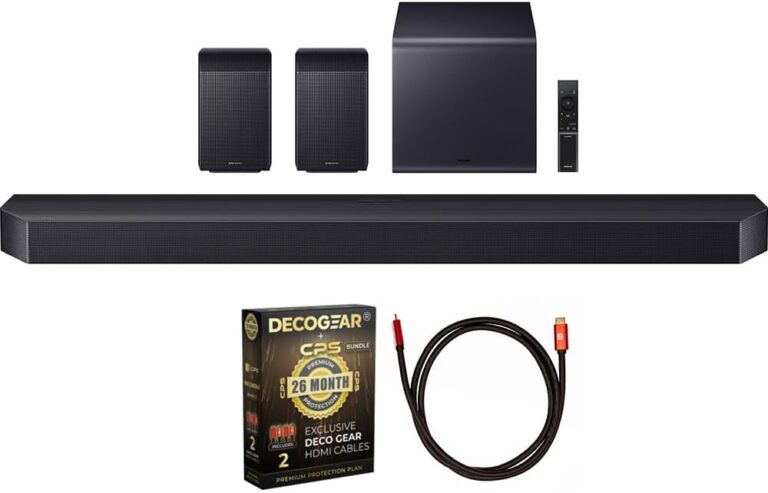
- Samsung HW-Q990D: Includes real wireless rear satellites — the closest a soundbar system gets to true 5.1 while keeping wiring minimal
- Bose Smart Soundbar 900: Bose’s PhaseGuide technology creates the most convincing directional surround from a single bar, particularly effective in smaller reflective rooms
When a Discrete 5.1 System Wins in a Small Room
The conventional wisdom that 5.1 systems “need space” is partly right but overstated. A carefully configured compact 5.1 system — using appropriately sized bookshelf speakers, a quality AVR with room correction, and smart cable management — can produce a listening experience in a small room that no soundbar can match. Here’s when to choose it.
- Room is 120–180 sq ft with one primary seating position: The sweet spot limitation matters less when there’s one sofa in one place
- Cinephile or audiophile priorities: Discrete channels deliver genuinely better directional audio cues, and quality bookshelf speakers trounce any soundbar for music
- Dialogue clarity is critical: A physical center channel speaker consistently outperforms even the best virtual center channel simulation
- Gaming matters seriously: Competitive gamers consistently prefer discrete surround for accurate enemy location cues — it remains superior to virtual surround
- Long-term investment mindset: A quality AVR and speakers can be upgraded piece-by-piece; soundbars lock you into a proprietary ecosystem
- You can run cables or use wireless rear kits: Several AVRs and systems now support wireless rear channels — the cable problem is solvable
- Room dimensions allow proper placement: In a 12×14 ft room, properly spaced speakers at 90–110° for surrounds is achievable
- Denon AVR-X1800H + Klipsch R-41M bookshelf system: Compact bookshelf speakers ideal for small rooms; Klipsch’s horn-loaded tweeters need less power for clean highs
- Yamaha RX-V6A + Monitor Audio Bronze 100 5.1: YPAO room correction is outstanding; Monitor Audio’s compact Bronze speakers image beautifully in small spaces
- Marantz NR1510 (slim AVR) + KEF Q150 system: The ultra-slim Marantz takes up minimal rack space; KEF’s Uni-Q drivers have superb off-axis response — critical for small rooms
- Pioneer VSX-934 + Polk Audio T-Series 5.1: Budget-conscious entry — excellent Polk room-filling efficiency, Pioneer’s MCACC calibration is underrated at this price
Room Size Decision Guide: What Actually Works Where
| Room Size | Dimensions (approx.) | Recommended Option | Why |
|---|---|---|---|
| Very Small | Under 100 sq ft (e.g. 9×10 ft) | 🏆 High-End Soundbar | No room to place surround speakers correctly; virtual surround via DSP performs better |
| Small Bedroom / Den | 100–130 sq ft (e.g. 10×12 ft) | 🏆 High-End Soundbar or Compact 5.1 | Either works with proper setup; soundbar wins for ease, 5.1 wins for dedicated cinema |
| Medium Bedroom / Small Living Room | 130–180 sq ft (e.g. 12×14 ft) | 🏆 Compact Discrete 5.1 | Enough room for proper 5.1 placement — discrete surround starts to clearly outperform virtual |
| Medium Living Room | 180–250 sq ft (e.g. 14×16 ft) | 🏆 Discrete 5.1 (or 5.1.2 Atmos) | 5.1 system fully justified; soundbar begins to struggle to fill this space |
| Large Room | 250+ sq ft | 🏆 Discrete 5.1 or 7.1 | Soundbar inadequate at this size; discrete system essential |
A square room of any size is an acoustic nightmare for any speaker system. When room length and width are equal, room modes stack on top of each other at the same frequencies, creating severe bass peaks and nulls that are very difficult to correct even with advanced room correction software. If your small room is close to square, prioritize a soundbar with strong DSP room adaptation (Sonos TruePlay or Sony 360 SSM) over a 5.1 system — the soundbar’s room correction handles mode problems more gracefully. If you go 5.1 in a square room, invest in bass traps for the corners as a non-negotiable first step.
How to Set Up a Discrete 5.1 System Correctly in a Small Room
If you decide that a discrete 5.1 system is right for your small room, correct setup and calibration are what separate a mediocre experience from an outstanding one. Here are the most critical guidelines:
Speaker Placement in Tight Spaces
| Speaker | Ideal Angle | Height | Small Room Tip |
|---|---|---|---|
| Front Left/Right | 22°–30° from center | Tweeter at ear level (36–42″) | Keep 6–18″ from front wall; toe in toward listening position |
| Center Channel | 0° (directly forward) | At screen level, angled toward ears | Decouple from TV stand with isolating pads to prevent cabinet resonance |
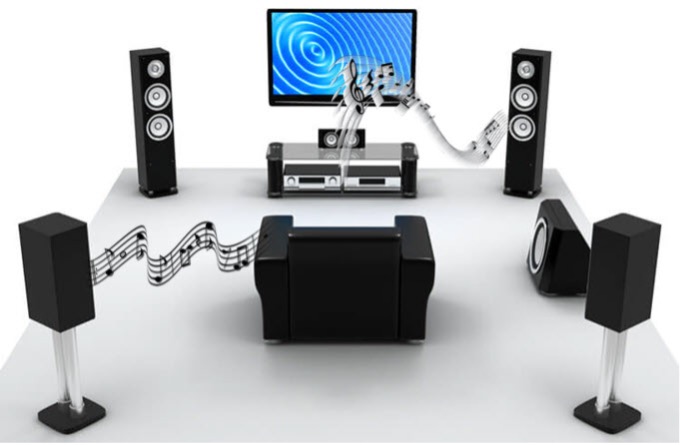
| Surround Left/Right | 90°–110° from listening position | 12–24″ above ear level | In very small rooms, use dipole/bipole surrounds instead of direct-firing — wider dispersion works better |
| Subwoofer | Flexible — use the crawl test | Floor level | Use the subwoofer crawl test to find the smoothest bass position in your specific room |
The Subwoofer Crawl Test
This is the single most effective technique for optimizing bass in a small room. Temporarily place the subwoofer at your primary listening position (on the sofa or chair). Play bass-heavy music or a bass test tone. Then crawl around the perimeter of the room at ear-seated height, listening for where the bass sounds most even and controlled. That location is where the subwoofer should be permanently placed. It sounds unusual but it works because of how room modes distribute — the position that sounds best at your listening spot when crawling is the position that produces the most even bass at the sitting position.
Set All Speakers to “Small” at the AVR
In your AVR’s speaker configuration, set all five speakers to “Small” regardless of their actual size. This routes bass below 80 Hz to the subwoofer rather than the main speakers — improving bass control and protecting smaller bookshelf speakers from over-excursion. Set the crossover at 80 Hz as a starting point, then adjust upward if the surrounds sound thin or downward if the bass from the subwoofer seems excessive relative to the other channels.
Use Your AVR’s Room Correction — But Verify It Manually
Audyssey (Denon/Marantz), YPAO (Yamaha), MCACC (Pioneer), and AccuEQ (Onkyo) all perform microphone-based room correction that meaningfully improves sound quality in small rooms. Run the full calibration with the microphone at your primary listening position. Then listen critically and check:
- Are dialogue frequencies clear and unmuddied?
- Does bass sound controlled or does it still boom at certain notes?
- Do surrounds sound integrated or do they stand out as separate sources?
- Adjust AVR’s Dynamic EQ and Dynamic Volume settings — these tend to work well in small rooms where volume levels are more moderate
Standard direct-firing surround speakers placed close to a listening position in a small room can sound unnaturally “present” — you become aware of them as separate sound sources, which breaks immersion. Dipole or bipole surround speakers radiate sound in two opposing or dual directions simultaneously, creating a more diffuse, enveloping sound field that avoids pinpointing. In a room where your surround speakers are less than 6 feet from your ears, bipole surrounds are strongly recommended over conventional direct-firing speakers.
Acoustic Treatment: The Game-Changer for Both Systems in Small Rooms
This is the most underrated factor in the entire small room audio debate. The single most impactful thing you can do to improve sound quality in a small room — with either a soundbar or a 5.1 system — is add basic acoustic treatment. This doesn’t mean lining every wall with ugly foam. It means targeted, strategic placement of absorptive and diffusive material at specific locations.
Priority Treatment Locations
- First reflection points on side walls: Use the mirror trick — have someone move a mirror along your side wall while you sit in the listening position. Wherever you can see your main speaker in the mirror is a first reflection point. Place an acoustic panel there on each side. This single step dramatically improves clarity and imaging for both systems.
- Corner bass traps: Floor-to-ceiling corner bass traps absorb the problematic room mode buildup that causes uneven bass in small rooms. They work regardless of whether you have a soundbar or a 5.1 system. Even two floor-standing traps in the front corners of the room make an audible difference.
- Rear wall treatment: For a 5.1 system, absorption on the rear wall reduces the strength of front speaker reflections arriving at the listening position from behind. For a soundbar, a slightly diffusive rear wall helps spread virtual surround cues more convincingly.
- A thick rug under the listening area: Bare hard floors are one of the biggest contributors to early reflections and flutter echo in small rooms. A thick area rug between the TV and the sofa makes an immediately audible improvement in clarity.
More acoustic treatment is not always better — especially in small rooms. Over-absorbing a small room makes it sound unpleasantly dead: voices sound close and dry, music loses its natural sense of space, and the listening experience becomes fatiguing. Acoustic treatment experts recommend targeting 60–70% soft surfaces and 30–40% reflective elements around the primary listening zone. Treat the specific problem points (first reflections, corners) rather than covering every wall surface.
Recommended Products: Best Picks for Small Rooms in 2026
The Sonos Arc Ultra features True Space technology with a dedicated woofer, nine amplified drivers including upward-firing units for Atmos, and Sonos’s acclaimed TruePlay room calibration — which uses your iPhone or iPad microphone to automatically adapt the soundbar’s EQ to your specific room acoustics. It’s one of the best tools available for getting great sound in a small, acoustically variable room without any manual tuning.
Sony’s flagship soundbar uses 360 Spatial Sound Mapping to create multiple phantom speaker positions around the room — giving the widest effective listening area of any current soundbar, which is particularly valuable in a small room where multiple people might be seated at different positions. It also supports optional SA-RS3S wireless rear speakers for genuine 5.1 surround without running cables.
The Denon AVR-X1800H is a 7.2-channel AV receiver with Audyssey MultEQ room correction, eARC, 8K video passthrough, and 75W per channel. Audyssey’s room correction is particularly strong at taming the bass mode problems common in small rooms. Pair it with compact bookshelf speakers for an outstanding small room 5.1 system.
The Klipsch Reference Theater Pack is one of the most recommended compact 5.1 speaker systems for small rooms. Its horn-loaded tweeters are highly efficient — requiring less power to achieve the same output, which means less amplifier strain at the moderate volumes appropriate for small rooms. The compact satellite design keeps visual footprint minimal without sacrificing sound quality.
No matter which system you choose, basic acoustic treatment at first reflection points and room corners will make more difference than any electronics upgrade in a small room. A set of 2-inch broadband absorption panels and corner bass traps is the most cost-effective audio improvement available.
The Verdict: Which Is Actually Better for Small Rooms in 2026?
There is no single winner — but there is a clear decision framework:
- Under 120 sq ft, rented space, bare walls, multiple seating positions, or Atmos is a priority: → A high-end soundbar (Sonos Arc Ultra, Sony HT-A7000, Samsung HW-Q990D) is the smarter choice. DSP-driven room adaptation genuinely works in tight reflective spaces, and the lack of physical surround speakers avoids the worst small-room acoustic problems.
- 120–180 sq ft, one primary seating position, cable routing possible, cinema/gaming focus, music listening matters: → A compact discrete 5.1 system with a quality AVR, bookshelf speakers, and room correction (Denon/Yamaha/Marantz) delivers an experience no soundbar can match for the same budget. The sweet-spot limitation is manageable with proper setup.
- Either scenario with no acoustic treatment on bare hard surfaces: → Add a thick rug and at least two corner bass traps before buying any electronics. The acoustic improvement from basic treatment costs $100–200 and rivals a speaker upgrade in terms of audible impact.
The honest truth: a $900 discrete 5.1 system in a properly treated 13×15 ft room will outperform a $1,200 soundbar for cinematic impact and music quality. But in a 10×11 ft bedroom with bare walls and a sofa against the rear wall, that same $900 soundbar will sound better than a $900 5.1 system placed the same way. Room treatment and correct placement matter more than the choice of system type.
Frequently Asked Questions (FAQ)
Q1: Can a 5.1 system actually sound good in a small bedroom?
Yes — with the right speaker selection and proper calibration. The keys are: use compact bookshelf speakers (not floorstanding towers), enable full room correction on your AVR, set all speakers to “small” at 80 Hz crossover, use the subwoofer crawl test for bass placement, and consider bipole/dipole surrounds instead of direct-firing if your surround speakers are within 6 feet of your listening position. A properly configured compact 5.1 system in a 12×14 ft bedroom is one of the best value home theater experiences available in 2026.
In small, moderately reflective rooms — yes, more convincingly than most people expect. The key limitation of virtual surround is that it works best when the room’s walls provide the reflections the soundbar’s DSP relies on. In small rooms, those reflections arrive quickly and consistently, which actually helps the virtual surround algorithm work correctly. In large, heavily treated, or acoustically dead rooms, virtual surround collapses — which is one reason premium soundbars are better suited to small rooms than large ones.
Q3: Is a high-end soundbar better than a budget 5.1 system?
Often, yes — particularly in small rooms. A $700 premium soundbar (Sonos Arc, Bose 900) will typically outperform a $400 AVR + budget 5.1 speaker package in everyday use, especially for Dolby Atmos content and ease of use. However, a $600 AVR paired with quality bookshelf speakers in the $300–400 range will match or exceed the soundbar for critical listening, music, and cinema in rooms over 130 square feet. The comparison becomes genuinely competitive at equivalent price points above $800 total investment.
Q4: Does Dolby Atmos work better on a soundbar or a 5.1 system in a small room?
For small rooms, premium soundbars with upward-firing drivers often deliver more convincing Dolby Atmos overhead effects than a standard 5.1 system (which has no height channels). To match soundbar Atmos performance with a discrete system, you’d need to upgrade to a 5.1.2 configuration (adding two ceiling or height speakers), which increases cost and complexity significantly. If Atmos is a priority and you’re on a single budget, a premium soundbar delivers more Atmos value per dollar in a small room.
Q5: What is the most impactful thing I can do to improve audio in a small room regardless of system choice?
Add acoustic treatment — specifically, address your first reflection points on the side walls and add corner bass traps. Room modes and early reflections are the biggest audio quality problems in small rooms, and they affect both soundbars and 5.1 systems equally. A dense area rug, two corner bass traps, and a couple of acoustic panels on the first reflection points will produce a more audible improvement than most speaker or electronics upgrades, at a fraction of the cost.
Drop the dimensions of your room and your budget in the comments below — our team will give you a personalised recommendation based on your exact listening space. We’ve helped hundreds of readers choose the right system for their room, and we love the specifics.